 Search



- Tajikistan becomes the second country in Central Asia, pioneering the "national partner" model to solve the remote networking dilemma
Previously, sending an X-ray required driving to the state center, but now it can be transmitted to other experts' desks in Duchamp in just a few seconds. ”At a rural hospital in GBAO, Gorno Badakhshan Autonomous Oblast, Tajikistan, the director breathed a sigh of relief as he looked at the image data that had just been successfully uploaded via satellite high-speed network on the computer screen. This is not a scene from a science fiction movie, but rather a daily reality in the Pamir Plateau as Starlink officially goes live in the country.
The key to the digital map of Central Asia
Recently, Star Chain officially announced on the social platform that Star Chain High Speed Internet has been launched in Tajikistan. Behind this news is a heavyweight agreement signed during the Dushanbe International Investment Forum in October 2025- the Tajikistan Communications Authority and Starlink Tajikistan (a wholly-owned subsidiary of SpaceX) officially signed an operating license.
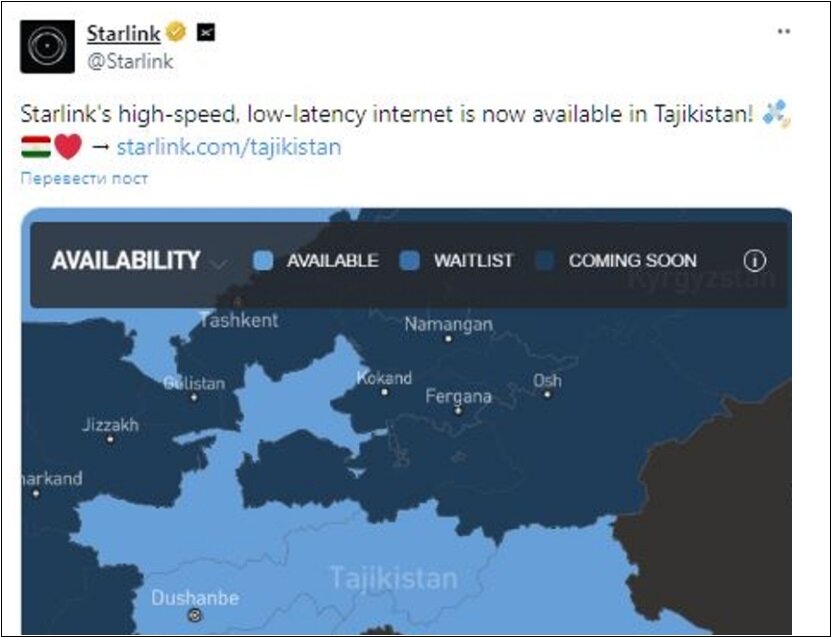
Thus, Tajikistan has become the second country in Central Asia to officially connect to the Starlink network, following closely behind Kazakhstan (which will be connected on August 13, 2025). According to the official coverage map of Starlink, the remaining three countries in Central Asia (Kyrgyzstan, Turkmenistan, Uzbekistan) are expected to complete the "networking" by 2026, with Uzbekistan having a clear plan to complete the access within this year.
How low orbit satellites can rewrite the fate of mountainous areas
Unlike traditional geosynchronous orbit satellites that have a latency of up to 600 milliseconds, Starlink relies on a 550 kilometer low orbit satellite constellation to compress network latency to 20-40 milliseconds, almost comparable to ground-based fiber optics.
For Tajikistan, where 93% of its land area is mountainous, this is disruptive, "said Bakhtovar Abdusatorzoda, General Manager of Tajikistan Telecommunications Corporation, in an interview. The core of this cooperation is not to serve cities, but to" fill the last gap in the digital divide.
The application scenario is already on the way:
Education: At the border primary school 400 kilometers away from Dushanbe, children will be connected to the global digital library through Starlink terminals, bidding farewell to the history of school closures caused by snowstorms leading to fiber optic cable interruptions.
Medical: Emergency centers in remote mountainous areas will have real-time remote consultation capabilities, and golden rescue time will no longer be wasted due to signal blind spots.
Government Affairs: The scattered rural administrative points in the canyon will achieve real-time data synchronization with the central government, and administrative efficiency is expected to increase by more than 40%.
The balance between national sovereignty and commercial efficiency in the Tajik model
Unlike some countries that directly purchase from SpaceX, Tajikistan has chosen a more cautious "national partner" path. Abdulsatorzoda emphasized, "All commercial agreements must be conducted through Tajikistan Telecom
This model constructs a triple "safety valve":
Traffic sovereignty: The state controls inbound and outbound traffic through state-owned telecommunications companies to ensure network security.
Tariff adjustment: To avoid foreign monopoly pricing, equipment costs and monthly fees will be tailored according to local purchasing power (it is expected that through subsidies, user terminal costs will be reduced by about 30% compared to global standard prices).

Compliance supervision: Strictly abide by domestic laws, and all data transmission must comply with national security standards.
Cost and Future: When 'Luxury Goods' Transform into' Infrastructure '
Although satellite communication equipment is often seen as an "expensive luxury", Abdusatorzoda revealed that through multiple rounds of negotiations with local authorities, the tariff plan will be highly flexible. We are negotiating a tiered pricing mechanism where public welfare institutions such as schools and hospitals will enjoy dedicated services close to cost price
With Kazakhstan taking the lead in completing tests in rural schools and opening them up to individual users, Tajikistan's follow-up means that tens of millions of marginalized populations in Central Asia are being pulled from "information silos" into the fast lane of the global digital economy. Key words: international news, star chain high-speed Internet
The landing of Starlink in Central Asia is not only an expansion of commercial territory, but also a deep game of geopolitical digital infrastructure - in the "roof of the world" where fiber optics are difficult to reach, signals from space are redefining the meaning of "connection".Editor/Cheng Liting
Comment





 Praise
 Collect
 Comment

 Share
Share


Write something~