 Search


- Harbin Railway transforms from a transit channel to an economic engine, driving cross-border logistics cooperation
On March 31, 2026, relying on the unique geographical advantages of the Eurasian hinterland, Kazakhstan is accelerating the transformation and upgrading of its railways from a single resource export channel to an international logistics hub. Through large-scale infrastructure investment, capacity enhancement, and digital reform, Kazakhstan strives to seize the opportunity in the competition of transit transportation between China and Europe, which brings new cooperation space for multinational logistics enterprises.
Build 3400 kilometers of new railways in five years
Kazakhstan is undergoing a large-scale upgrade of its railway infrastructure. In the next 35 years, the country plans to build 3400 kilometers of railways, while electrifying 1000 kilometers of main lines and connecting 5 international transportation corridors, bringing the total railway mileage to over 16000 kilometers.
The increase in transportation capacity is also significant. By 2025, the railway freight volume in Kazakhstan will reach 320 million tons, a year-on-year increase of 5.5%. By 2026, this number is expected to increase to 343.6 million tons, with transit transport volume expected to exceed 55 million tons. In terms of hardware, 149 locomotives and 2323 freight cars will be added in 2025, and an additional 236 locomotives and 1373 container flatcars are planned for 2026. Over the past decade, Kazakhstan's cumulative investment in the railway sector has exceeded 35 billion US dollars.
Construction of the third railway corridor between China and Kazakhstan begins
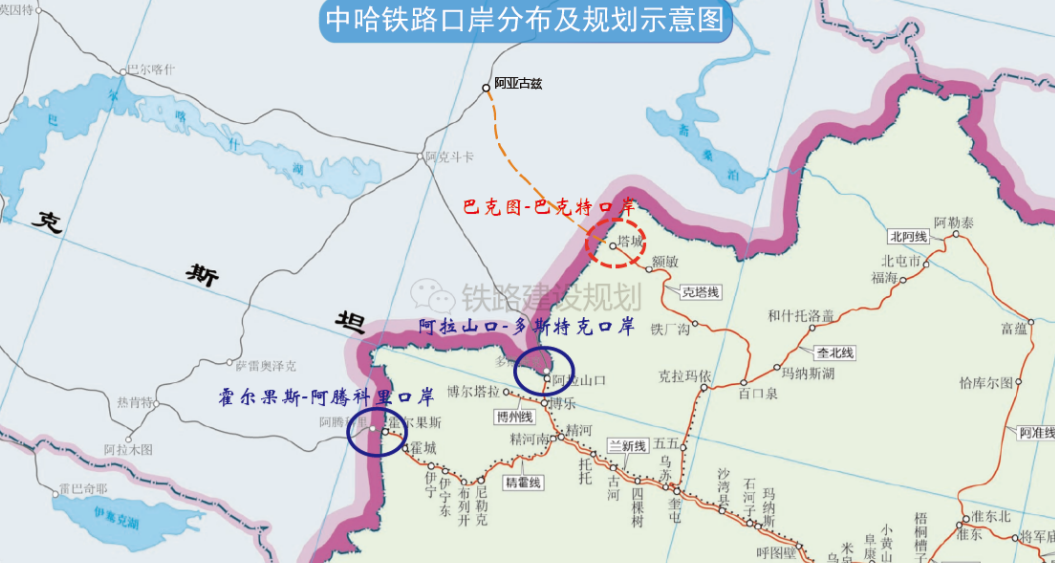
China Kazakhstan border cooperation has made new progress. The construction of the Bakt Ayaguz railway has started, and this third railway transit channel between China and Kazakhstan will effectively alleviate the congestion pressure at existing ports, further strengthening Kazakhstan's position as a transit hub in China Europe land transportation.
A breakthrough has also been made in the cross sea passage. By 2025, the freight volume of this channel will reach 9.5 million tons, and it is planned to increase to 11.4 million tons by 2026. Aktau Port and Kurek Port are undergoing upgrading and renovation, with an annual capacity of 30 million tons in the future. There has also been a significant improvement in terms of timeliness. It is expected that by the end of 2026, the time for goods to be transported from the Chinese border to the Caspian Sea coast will be reduced from 84 hours to 55 hours, greatly enhancing the attractiveness of transit transportation.
Digital platform breaks through the bottleneck of clearance efficiency
At the same time as hardware upgrades, Kazakhstan is cracking logistics efficiency pain points through digital means. The introduction of automated scheduling and automatic block technology in the railway system effectively shortens the interval time between trains and enhances the ability to ensure operational safety.
In terms of process simplification, Kazakhstan is promoting the construction of one-stop digital platforms and digital trade corridors, achieving 24-hour service and automated auditing, and focusing on solving the long-standing problems of cumbersome procedures and long approval cycles. These measures will significantly enhance the transit logistics experience and provide a more efficient and transparent service environment for multinational logistics enterprises. Keywords: International News Network, International Cooperation
The restructuring of the global transportation pattern has led to a surge in demand for land transportation between China and Europe. Kazakhstan has the inherent advantage of becoming a transit hub between Europe and Asia. Only by working together to improve logistics efficiency can we transform railway advantages into stable revenue and jointly build a new artery for Eurasian logistics. Multinational logistics companies can rely on the Eurasian network to help connect freight flows, optimize multimodal transport, and jointly promote the value realization of railway hubs.Editor/Gao Xue
Comment


 Praise
 Collect
 Comment

 Share
Share


Write something~