 Search


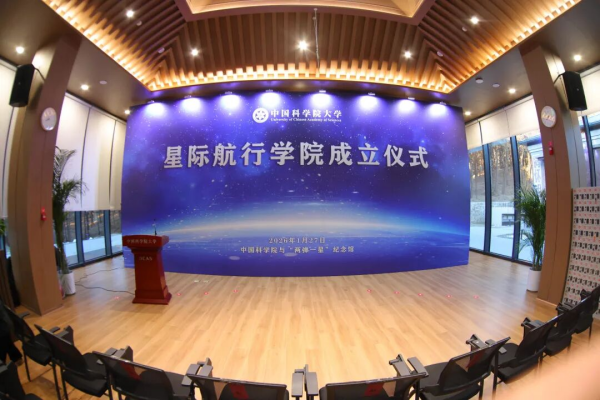
- On January 27, 2026, the Interstellar Navigation College of Chinese Academy of Sciences was officially established
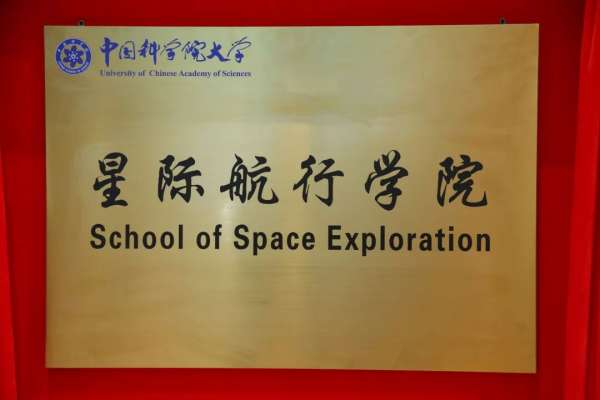
On January 27, 2026, a brand new plaque was officially unveiled at the Chinese Academy of Sciences and the "Two Bombs and One Star" Memorial Hall, a special place connecting the glorious history and future vision of the Republic - the Interstellar Navigation School of the University of the Chinese Academy of Sciences was announced. This ceremony is held here, symbolizing the inheritance and extension of the Chinese aerospace spirit lineage. Academician Zhu Junqiang, Director of the Bureau of Strategic High Technology Research of the Chinese Academy of Sciences, served as the first president of the college, which marks that China's higher education system is making strategic layout in a more profound and cutting-edge field, and has built a cradle of core talents in advance for the country's leapfrog development in the field of interstellar navigation in the next 10 to 20 years.
Dealing with the window period of deep space exploration
The establishment of the college is a strategic decision in response to the needs of the times. According to the plan, the next 10 to 20 years are regarded as a critical window period for China's interstellar navigation field to achieve leapfrog development. During this period, the original innovative research and technological breakthroughs in this field will directly reshape the global pattern of deep space exploration and have a profound impact on the country's overall competitiveness. The establishment of the Interstellar Navigation Institute is the key measure taken by the University of the Chinese Academy of Sciences to actively seize the commanding heights of science and technology and systematically arrange the cultivation of high-end talents in the field of interstellar navigation. Its core mission is to provide solid, reliable, and cutting-edge talent support for major strategic needs such as deep space exploration and space science research for the country.
Creating integrated cutting-edge courses
In the top-level design of talent cultivation, the college has demonstrated a grand architecture and the concept of integrated innovation. Since the decision to establish in November 2025, the college has planned to build a comprehensive curriculum system covering 14 first level disciplines/professional categories, including aerospace science and technology, planetary science, physics, astronomy, computer science and technology, etc. On the basis of inheriting 97 existing related courses of the University of the Chinese Academy of Sciences, the college will focus on adding 22 core courses. These new courses directly point to the forefront of disciplines, including principles of interstellar power and propulsion, perception and utilization of interstellar navigation environments, planetary dynamics and livability, and even forward-looking directions such as interstellar sociology and governance. This course aims to break down traditional disciplinary barriers and achieve a deep integration of basic science, cutting-edge technology, and practical application scenarios. Keywords: New News Video, New News Video News
Building an Immersive Education Platform
In order to transform cutting-edge theories into the ability to solve practical problems, the college has invested heavily in the construction of teaching practice platforms. The college will mainly rely on the existing high-level scientific research platforms in Beijing Huairou Science City, including cutting-edge science, key technologies, and strategic applications. On this basis, the college plans to build six distinctive teaching practice platforms, including unmanned aerial vehicle intelligent patrol simulation platform, space science satellite full process teaching practice platform, and interstellar navigation space earth collaborative experimental teaching and innovation platform. These platforms aim to create an "immersive" training environment for students, from design, simulation to practical simulation, allowing them to experience the full chain process of close to real scientific research and engineering tasks during the learning stage, greatly enhancing their innovation and practical abilities. The college has also established a teaching and training guidance committee led by top scientists such as Academician Wang Chi, Academician Zhu Junqiang, and Academician Di Qingyun, to ensure the top-notch level and correct direction of talent cultivation.Editor/Gao Xue
Comment



 Praise
 Collect
 Comment

 Share
Share


Write something~