 Search


- F-theta field mirror achieves laser pointing and hitting, ensuring consistent light spot within the processing area

Hello everyone, welcome to this issue of CASTECH Classroom. Today we will talk about a crucial optical component in laser precision machining equipment - the F-theta field mirror.
You may have seen lasers accurately marking and cutting complex patterns on metal. Have you ever thought about how a laser beam scanned by high-speed deflection of a galvanometer can ensure that every corner of the processing surface leaves equally fine and clear marks?
The secret behind this is largely hidden in the F-theta field lens.
F-theta Field Mirror: The Core Optical Component of Laser Scanning
The basic structure of a scanning system is as follows: the laser beam is deflected by two mutually orthogonal X and Y scanning mirrors, and the beam is converged on the working plane through an F-theta field mirror. The following diagram shows the working schematic of the scanning system:

In the scanning system, the core task of the F-theta field mirror is to converge the rapidly deflected laser beam reflected by the galvanometer into a well focused and energy concentrated light spot on the worktable, and ensure that this light spot maintains a relatively consistent size and energy distribution within the designed scanning range.
Without it, laser scanning would face major problems: when scanning to the edge, the speed would increase, the light spot would become larger and deformed, resulting in deep and shallow lines and distorted graphics. F-theta field mirrors are designed to address these issues and are key to ensuring consistent processing quality. When scanning to the edge, the line speed increases and energy deposition decreases. In addition, the effects of field curvature and astigmatism can cause defocusing and distortion of the light spot, resulting in deep and shallow processing lines and distorted graphics.
The core working principle of F-theta field mirror
Core issues and solutions
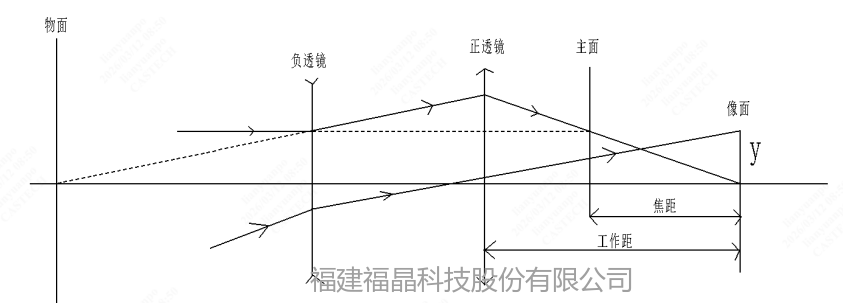
The image height (y) and scanning angle (θ) of a conventional lens satisfy a nonlinear relationship of y=f · tan θ. As the scanning angle increases, the growth rate of the image increases, resulting in uneven scanning speed (edges faster than the center), and the control system needs to perform real-time trigonometric calculations, leading to high algorithm complexity. The F-theta field mirror corrects the relationship to approximately linear by introducing negative distortion: y ≈ f ·θ. This means that the galvanometer rotates by a unit angle, and the light spot moves approximately a fixed distance on the processing plane. The control system only requires simple proportional mapping to achieve high-speed and accurate scanning positioning. With good aberration correction, a relatively consistent focusing effect and energy distribution can be achieved throughout the entire frame.
Design for achieving long working distance: anti long distance structure
In order to meet the requirements of laser processing systems for longer working distances, F-theta field mirrors often adopt an anti telephoto optical structure (a combination of negative optical power in the front group and positive optical power in the back group). The front negative lens causes the beam to diverge first, while the rear positive lens focuses it; This design significantly shifts the second principal point of the optical system backwards (even behind the last side of the lens), thereby achieving a back working distance greater than the effective focal length. For precision machining applications that require vertical incidence (such as cutting and drilling), a telecentric design can be further adopted, with the exit pupil located at infinity to ensure that the scanning beam is vertically incident on the workpiece, eliminate perspective distortion, and improve the consistency and machining accuracy of the light spot at the edge of the large field of view.
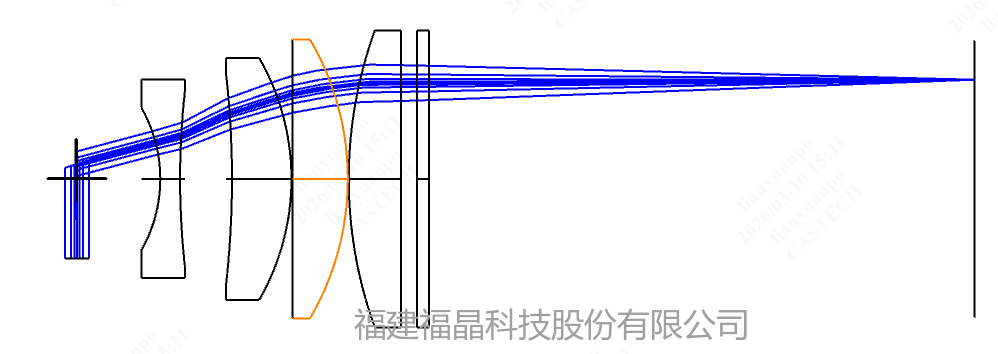
Conventional single wavelength field mirrors face significant challenges in femtosecond laser processing systems. Femtosecond laser pulses have an extremely narrow time-domain width (on the order of 10-15 seconds), and according to the Fourier transform limit, their corresponding spectral bandwidth is usually several nanometers to tens of nanometers, rather than strictly monochromatic light. Conventional field mirrors optimized for a single center wavelength can result in color differences among different spectral components, leading to an increase in the focused spot size, a decrease in peak energy density, and blurred processing edges. Therefore, it is necessary to combine the theory of achromatic design with the spectral characteristics of femtosecond lasers for special design to correct chromatic aberration and ensure good focusing over a wide spectral range.
Analysis of Key Parameters and Selection Considerations for F-theta Field Mirrors
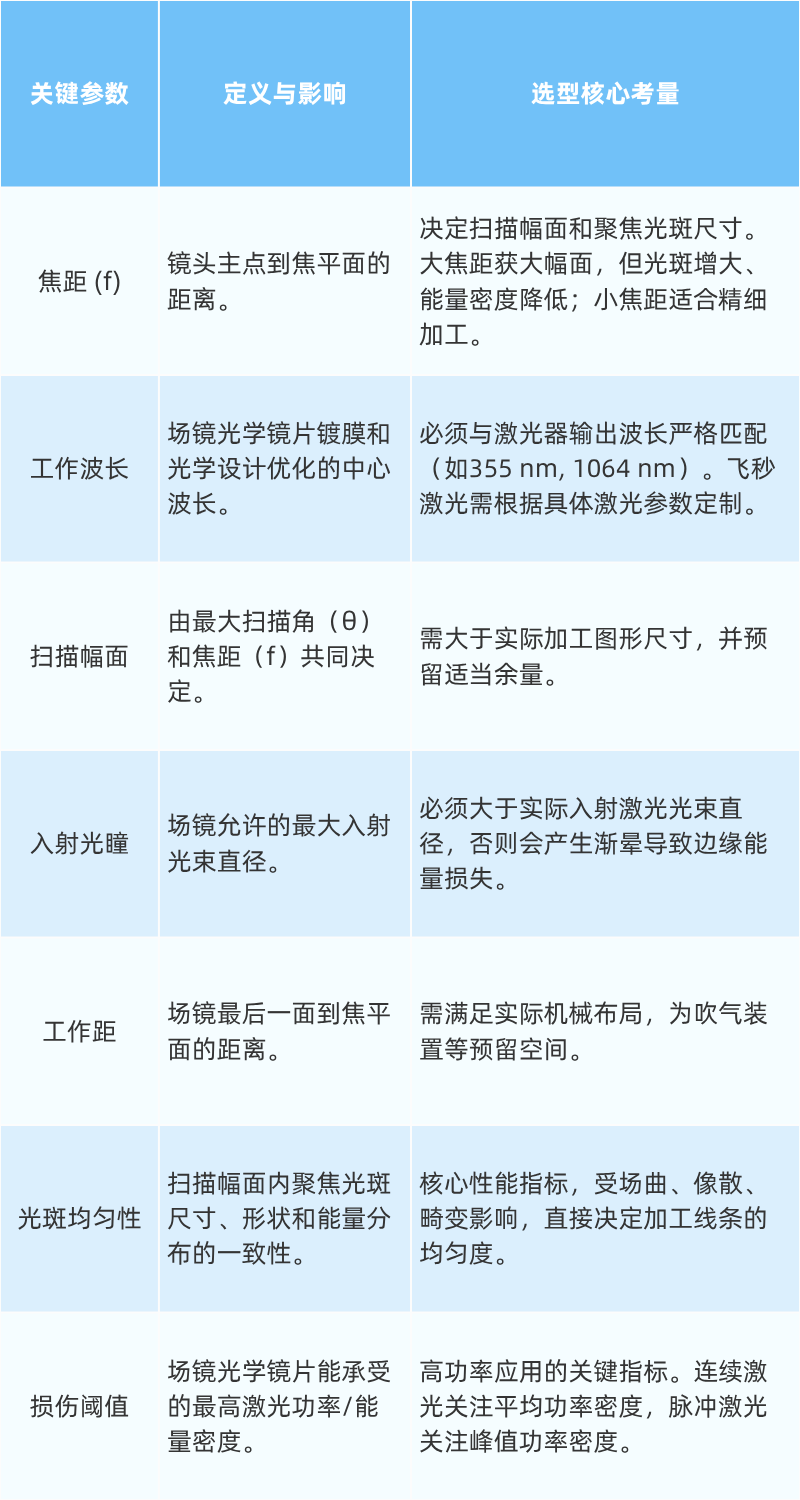
To select the most suitable field lens for your application, you first need to understand the following key parameters - they determine the degree of matching between the field lens, laser, and processing requirements.
General selection logic
Clarify processing requirements (material, format, precision) → Determine laser parameters (wavelength, power, pulse width) → Preliminarily select focal length and scanning angle → Check incident beam diameter and working distance → Confirm focused spot quality, uniformity, and power carrying capacity → Select standard products or initiate customization
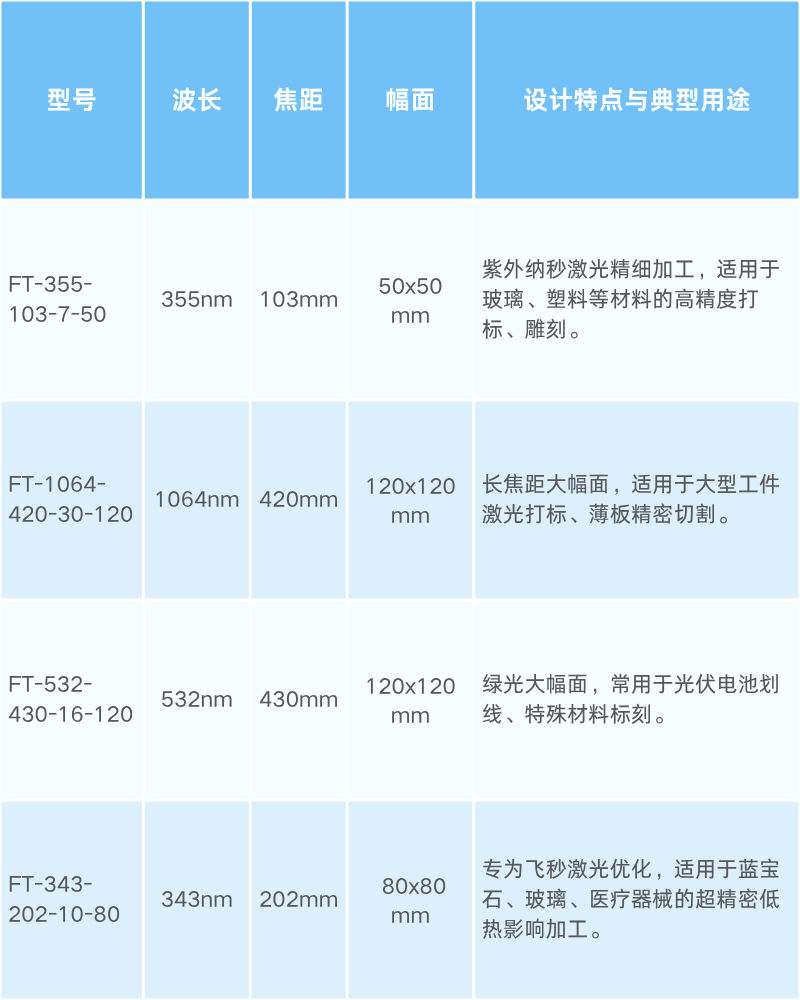
List of CASTECH Field Mirror Products
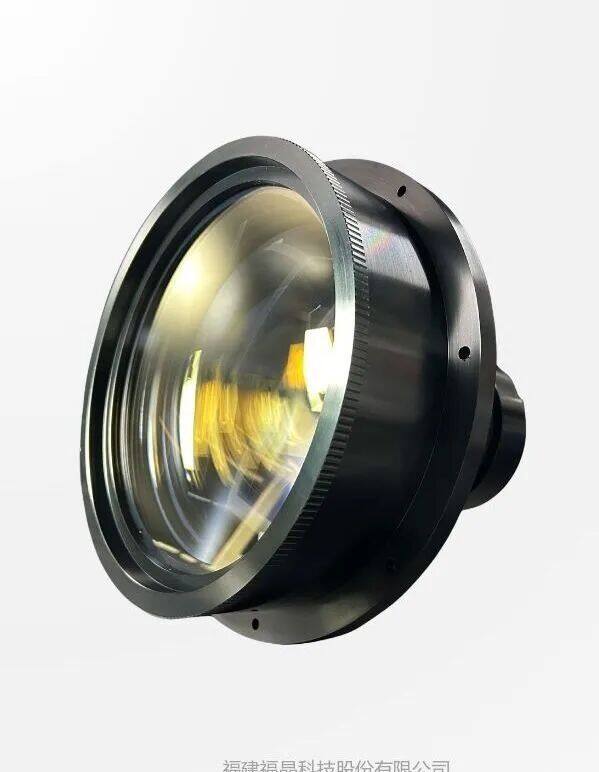
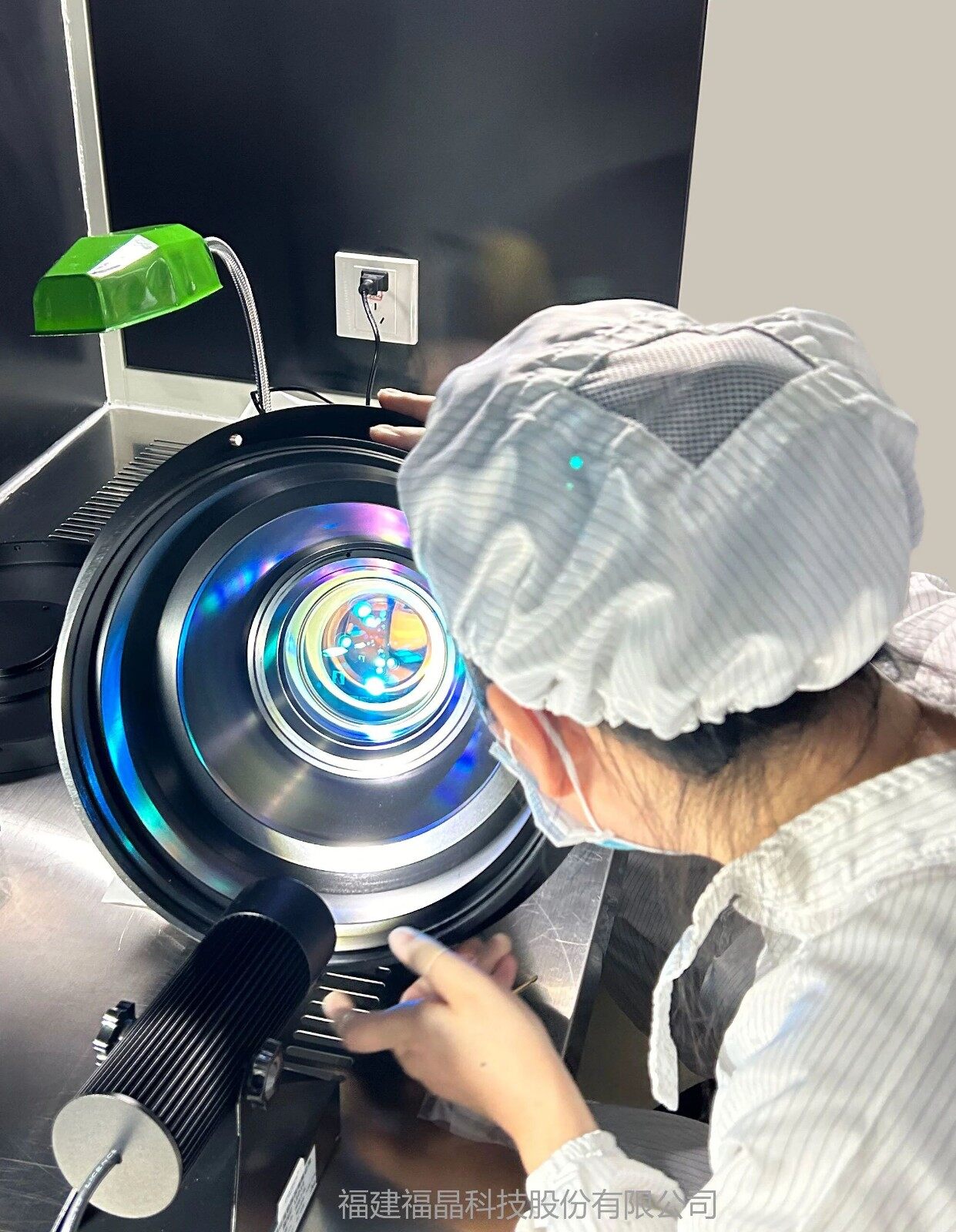
Based on our strong design, processing, coating, and assembly capabilities, we provide F-theta field mirrors that meet the mainstream needs of industrial lasers. Here are some representative products:
Application of F-theta Field Mirror in Industrial Field
F-theta field mirror is the core optical component of laser precision machining, and its unique linear scanning characteristics make it indispensable in multiple key fields:
Universal processing: laser marking/engraving, cutting, welding - ensuring clear edges of graphics, smooth cutting seams, and consistent welds.
Precision manufacturing: 3D printing (selective laser melting/sintering), low damage cutting and slicing of new energy battery cells.
Cutting edge technology: Combined with picosecond and femtosecond ultrafast lasers, it is used for ultra-fine microfabrication of medical stents, brittle materials (such as glass and ceramics), flexible circuit boards, etc., utilizing its "cold processing" characteristics to achieve almost no heat affected zone processing effect.
Conclusion
An excellent F-theta field mirror is a reliable guarantee for the excellent performance of laser equipment. It is not only the result of optical design, but also a reflection of the full process manufacturing strength from high uniformity optical materials, ultra precision machining, low loss and high damage threshold coating to precision assembly and testing.
CASTECH relies on its profound technological accumulation to not only provide standardized high-performance field mirrors, but also provide customized solutions for special wavelength, large format, high-power, and ultrafast laser needs.Editor/Gao Xue
Comment






 Praise
 Collect
 Comment

 Share
Share


Write something~