 Search


- The new round of planning will plan a total of 80 connecting roads along the 197-kilometer border between Guangzhou and Foshan
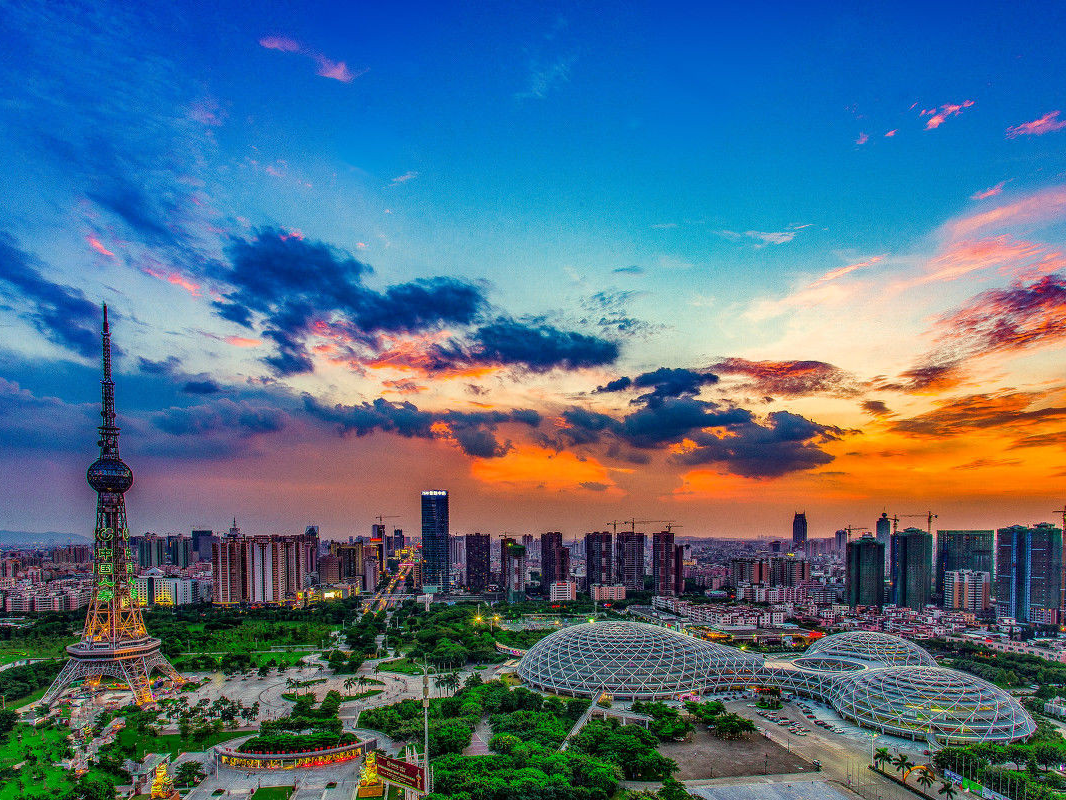
On the morning of January 11, 2021, the Guangzhou Municipal Bureau of Planning and Natural Resources held a press conference on "Guangzhou-Foshan Road Connection Planning Revision". The new round of planning has planned a total of 80 routes along the 197-kilometer border between Guangzhou and Foshan. By connecting roads, in the future, the two central areas of Guangzhou and Foshan will reach each other in 30 minutes, and key areas and major hubs will be reached in 60 minutes. At the same time, it will ensure that the central city of Guangfo can quickly reach the major cities in the Bay Area in 2 hours. It is reported that in the future, there will be 27 rail transits in Guangzhou and Foshan, 18 of which will be urban rails.
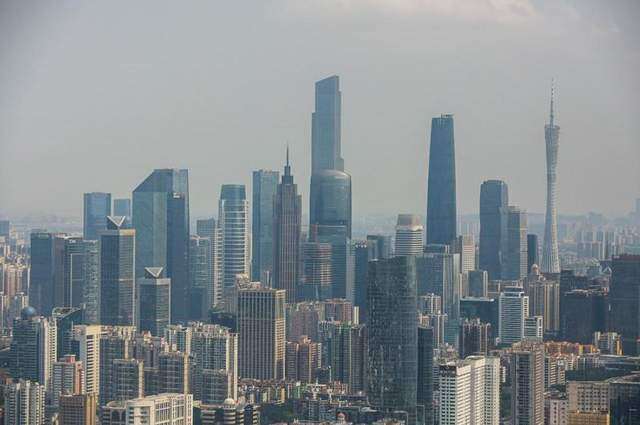
Status: 28 roads have been built to connect the Guangzhou-Foshan metropolitan area basically formed
The two cities of Guangzhou and Foshan have obvious advantages in the development of the same urbanization. The border is 197 kilometers, and the straight-line distance of the central city is only about 20 kilometers. Compared with the 50 kilometers development radius of international metropolitan areas such as Tokyo and New York, it has inherent advantages.
As early as 2006, the planning departments of the two cities in Guangzhou and Foshan jointly prepared the "Guangzhou and Foshan Road System Connection Plan". This plan is a pioneer and the first cross-city cooperation project in China that breaks through the administrative division of "co-editing and co-approving". The road traffic special planning research has clarified 55 planned connection channels, opened the prelude to the integration of Guangzhou-Foshan traffic, and achieved obvious results. Today, 28 connecting roads have been built and 6 are under construction. The number of completed passages has doubled compared with 2006, which has promoted closer commuting and life travel between the two cities.
At present, the Guangzhou-Foshan metropolitan area is basically formed, and the level of transportation integration is leading domestically. In 2019, the passenger flow between Guangzhou and Foshan was 1.76 million people per day, an increase of 2.8 times compared with 2005, accounting for 44% of Guangzhou's outbound trips and 56% of Foshan's outbound trips. The proportion of Guangzhou-Foshan passenger flow in the Bay Area cities The largest; the passenger flow from Guangzhou to Foshan is close to the passenger flow from the central four districts of Guangzhou to Panyu District and Baiyun District; the commuting passenger flow between Guangzhou and Foshan increased from 18.4% in 2005 to 40.8% in 2019. Travel and commute accounted for the same proportion; the total commuter population reached 340,000, of which 40% were employed in Guangzhou, Foshan, and 60% were employed in Foshan, Guangzhou, and the characteristics of two-way commuting were obvious.
However, the road traffic between Guangzhou and Foshan is still inadequate, especially the traffic congestion troubles the citizens of the two places. Expressways between Guangzhou and Foshan (Guangfo Expressway-Beihuan Expressway, Shabei Interchange, Guangqing Expressway, North Second Ring Expressway, etc.) show normal congestion; the connecting roads in the central city of Guangfo (Longxi Avenue, Guangfo Shinkansen, etc.) ) There are many congestion points, with an average saturation of 0.89. In addition, the construction rate of inter-city expressways is high, and the construction of urban roads is relatively slow. In the 13 years since the implementation of the plan, the completion rate of the total number of passages planned in the 2006 edition was 51%. Among them, the completion rate of expressways has reached 80%, and the progress is relatively satisfactory; but the construction of urban roads is relatively slow, with a completion rate of only 45%.
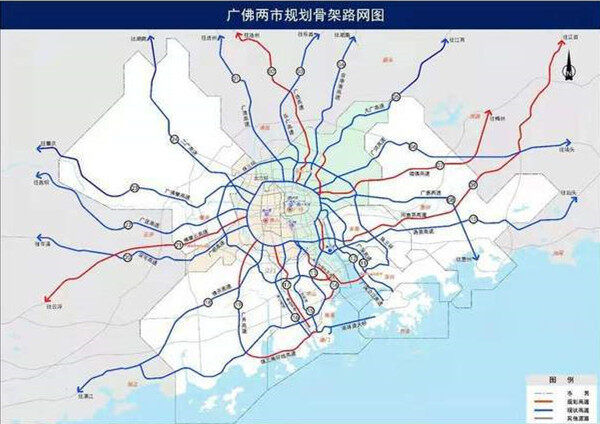
Planning: Layout 80 connecting roads between the two downtown areas of Guangzhou and Foshan within 30 minutes
The plan implements the requirements of "Guangfo Pole Leading and Leading Role" proposed in the "Guangdong-Hong Kong-Macao Greater Bay Area Development Plan Outline", and further promotes the integration of Guangfo and the "1+4" Guangfo high-quality development integration pilot zone Construction. It is planned to form an integrated backbone network of the Guangzhou-Foshan Metropolitan Area with "two rings, twenty-four shots and seventeen connections". A total of 80 connecting roads are planned along the 197-kilometer border. The total number is 25 more than the previous round of planning. From 2020 to 2025, 31 joint construction projects need to be promoted and accelerated preliminary research.
In terms of spatial distribution, there are a total of 20 plans in the northern region (north of Phase 3 of Huanan Road) to strengthen the connection between Huadu and Sanshui, and promote the construction of new energy and intelligent networked automobile industry and ecological and cultural tourism industry; central region (South China) Road Phase III-Guangming Expressway) plan a total of 40, strengthen Guangzhou South Railway Station-Foshan Sanlong Bay-Guangzhou Liwan Hailong Pilot Area, and Baiyun-Nanhai, Liwan-Nanhai Pilot Area to improve the travel difficulty of Jinshazhou and Guangfo commuter circle The travel environment will promote the construction of two-way opening up new highlands in the Bay Area; a total of 20 plans are planned in the southern region (south of Guangming Expressway) to strengthen the connection between Nansha and Shunde, and promote the development of advanced manufacturing and service industries in the free trade zone.
From the perspective of channel functions, there are 21 high-speed strategic channels and 59 urban life roads, forming a Guangfo integrated road transportation network with direct center access, hub connectivity, border stitching, and joint construction and sharing.
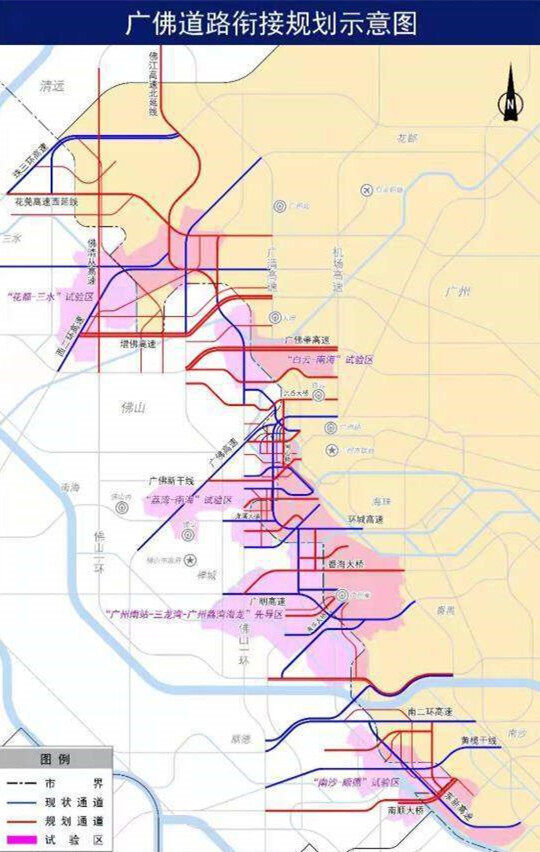
Integration: Building a city in the super metropolis of Guangfo
The focus of the last round of planning was to smoothly connect the dislocation and decapitation of the planned road networks of the two cities in the junction area, so that they can be connected. In this plan, in accordance with the overall goals and ideas of building a city in the Guangzhou-Foshan super metropolitan area, the entire city-wide road network of Guangzhou and Foshan will be built to achieve good connections.
The plan is to take Guangzhou-Foshan as the pole, with 24 radiation channels directly connecting to the Bay Area and radiating to the eastern and western Guangdong and northern Guangdong, ensuring the stability and reliability of the Guangzhou-Foshan central area to major cities in the Bay Area within 2 hours; strengthening Guangzhou Baiyun The airport quickly connects with the Pearl River Delta Hub Airport and Shenzhen Bao’an Airport, providing no less than 2 highway connections between the airports, realizing 80-minute mutual communication; encrypted 40 roads connecting the two downtown areas, and the average channel distance is 3.3km from the current state Reduced to 1.3km, the road travel time was shortened from about 45 minutes to about 30 minutes, and a 30-minute living circle in the same city was built; the high-speed road in the outer area was strengthened, and 7 parallel diversion channels were added to enable the transit traffic to pass through Guangfo The proportion of the central urban area has been reduced from 57% to 31%, alleviating the cross-city structural traffic congestion in the Shabei section of Guangfo Expressway and Guangqing Expressway, and supporting the development of urban space and industrial integration of the two cities.
In addition, in the past ten years or so, the two cities of Guangzhou and Foshan have focused on the construction of high-grade road networks, and the construction of local roads serving the lives and commuting of the two cities has been lagging behind. This round of planning focuses on building a multi-level road network such as transit, commuting, industrial transportation, and life distribution. Among them, strengthen the integration of secondary road networks in key intra-city areas such as the 1+4 Guangzhou-Foshan high-quality development integration test zone and the Jinshazhou area. There are 60 planned connection roads in the test area, which is 2.75 times more than the current situation. The Jinshazhou area plans to connect channels. The number is 2.25 times the current status. Editor/He Yuting
Comment


 Praise
 Collect
 Comment

 Share
Share


Write something~