 Search


- China has strengthened water cooperation with countries along the Belt and Road to help improve local production and living standards
In recent years, China has strengthened water cooperation with countries along the Belt and Road to help develop, utilize, manage and protect water resources, so that local people can drink safe and clean water, and help improve local production and living standards.
Water is the source of life, the essential of production, and the foundation of ecology. In recent years, China has strengthened water cooperation with relevant countries to assist in the development, utilization, management and protection of water resources, so that local people can drink assured water and use clean water, and help improve local production and living standards.
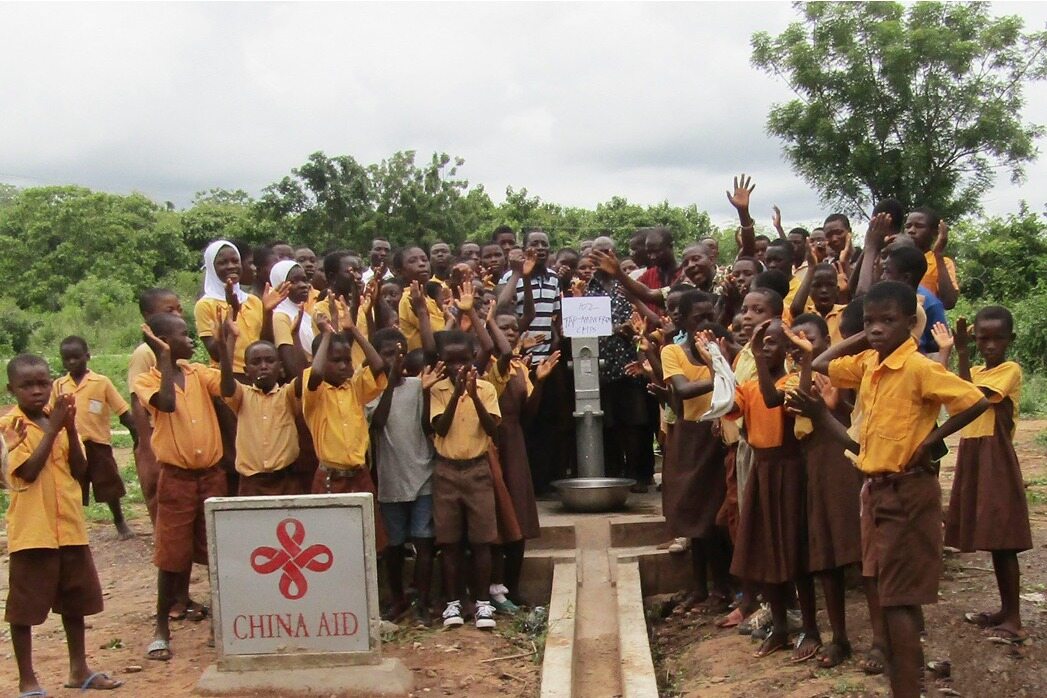
Ghana aids construction of 1,029 wells
Early in the morning, Qin Jian, the head of Jiangxi China Coal Ghana Company, and two Chinese employees set off from Accra, the capital of Ghana, and drove about 2 hours to the Guayuzi Village Primary School in the Eastern Province. There is a Chinese-aided well 20 meters away from this elementary school. The villagers who lined up to fetch water gently pressed the water pump with their hands, and the clear well water slowly flowed out of the tap.
"The Chinese family who helped us dig the well is here!" Atuya Otto, the vice principal of the elementary school, said with a smile.
Previously, local villagers could only find water in ponds or ditches where rainwater was collected. Not only was there no guarantee, but it was also unsanitary. Now, they are looking forward to a steady stream of clear and sweet well water, and digging well water with basins and buckets will become a new local landscape.
The 1,029 wells of the China-aided Ghana Water Well Project are distributed in 832 villages in 6 provinces across Ghana. There are many construction sites, and all of them are in remote rural areas. The work intensity of the project team is very high. Qin Jian said that according to the experience of drilling wells in China, water will usually be produced after drilling 10 to 20 meters; but in Western Africa, water can be produced at a depth of 40 meters, which is "good luck". Sometimes, even if it hits the water. 60 meters, there is not necessarily water. "It makes us very happy to be able to drill a well for the locals."
The experience of digging wells in the northern village of Tuna Yuleyeli impressed the project team. The local geological conditions are complicated, and several wells have been drilled in a row without water. The project team plans to move the wells to other villages so that the two villages can share the wells. After learning about it, the villagers of Tuna Yulayeri made a special trip to find the Chinese staff and asked to "try again." The project team then transferred large-scale survey equipment from China, used various technical means to increase the scope of the survey, and finally found a suitable well-drilling site. On the day the water came out, the villagers gathered together and sang and danced to express their joy.
In 2019, China's aid to Ghana's water well project was successfully completed and handed over, benefiting more than 500,000 Ghanaians. Cecilia Dapa, Minister of Environment, Sanitation and Water Resources of Ghana, expressed his sincere gratitude to the Chinese government and project team members: “The aid of the Chinese government is highly in line with Ghana’s needs. We must use and maintain these wells to make them more effective. , A longer-lasting effect."
Columbia upgrade water plant
Meet the water needs of millions of people and produce huge environmental benefits. The Tibitok Water Plant is located on a hill about 40 kilometers north of Bogotá, the capital of Colombia. It draws water from the Bogotá River that flows through the foot of the mountain. Residents of a small city supply tap water. Since its establishment in the 1950s, due to the long-term direct discharge of sludge and sewage, a "sludge lake" with a depth of 3 meters and an area of 540,000 square meters has been formed near the water plant. In recent years, due to the deterioration of river water quality, the processing capacity of water plants has dropped to 5.5 cubic meters to 7.5 cubic meters per second.
In February 2021, the Tibitok Water Plant upgrading project contracted by China Power Construction Group Co., Ltd. was officially launched. It is planned to restore the processing capacity of the water plant or even exceed the initial design level by building new facilities and upgrading equipment. The water needs of 10,000 to 5 million residents.
The treatment of the "sludge lake" is the first step in the upgrading project. "We have studied the construction design in detail, formulated clear construction measures, and strived to create high-quality projects in the most efficient manner." Colombian civil engineer Yolanda Galeano said that the original water plant did not have a sludge sewage treatment system , The waste water produced can only be discharged directly. The transformed water plant will be equipped with a complete treatment system, the sludge will be treated in a special area, and the sewage will be recycled to save water resources.
At the moment, construction workers are building a road connecting the outside with the "sludge lake" in preparation for the transportation of dredging and dredging equipment. China and Colombia jointly formed a construction team, including technicians in various fields such as civil engineering, machinery, electrical, automation and control, to jointly promote the implementation of the project. Project manager Bai Xuebin said: “The residents around and downstream of the water plant will benefit from the upgrading of the water plant. This is a project that will produce huge environmental benefits.”
The cooperation between Galiano and the Chinese team was "happy and fruitful." He said: "The cooperation between countries in the field of public services is very important and is closely related to people's lives. Chinese technology and culture have brought us useful enlightenment."
Kazakhstan undertakes irrigation project
Taraz, located in the Zhambyl region of southern Kazakhstan, is one of the oldest cities in Kazakhstan and an important post on the ancient Silk Road. For thousands of years, under the nourishment of the Taraz River, the residents of this ancient border city have gradually formed a production and lifestyle based on agriculture. However, because it is located in the hinterland of Eurasia and is adjacent to the desert, Taraz City is still extremely arid, and it is urgent to improve irrigation efficiency.
At the beginning of 2020, the Zhambyl State Agricultural Irrigation Project undertaken by China Civil Engineering Group Co., Ltd. was officially launched in Taraz. According to Zhou Lidong, project manager of the Kazakhstan branch of China-Turkey Group, the project aims to increase the supply of irrigation water, expand the planting area, optimize the growth conditions of crops, and improve the modernization of agriculture in the Taraz River and Axia River basins by rebuilding old canals. .
Kanat is a native of Taraz, and his family has been farming for generations. His family’s vegetable plot is located next to the project canal. According to him, the old canal has been in disrepair for a long time and is full of loopholes, making it difficult to perform irrigation. Because of the lack of water, nearly half of the family’s land cannot be cultivated. "After the completion of the new canal, the arable land area of my family can almost double, and corn, fruits, and alfalfa can be planted." In addition to increasing the irrigation area, the project can also greatly increase the utilization rate of water resources. The chief engineer of the project Rashih said that the Axia-Taraz irrigation canal adopts advanced channel anti-seepage irrigation technology, which can save nearly 40% of water, effectively alleviating the contradiction between local agricultural irrigation water demand and water supply, and improving The output of crops and grain is of positive significance for realizing the coordinated development of local agricultural production and environmental protection.
"Although I haven't worked here for a long time, I have learned a lot." The Kazakh girl Eman once studied Chinese in China and is currently working as a project translator. She is one of hundreds of local employees recruited by the project. For more than 4 months in the project team, she has not only further improved her language skills, but also learned from her Chinese colleagues the professional knowledge of civil engineering construction contract conditions review, project budgets, and prefabricated parts installation. "My goal is to become an excellent project assistant. ".
According to the plan, the Taraz irrigation project will be completed in the summer of 2021. Zhou Lidong said: I hope that under the impetus of this project, the local area can gradually form a one-stop industrial chain from the cultivation, processing and sale of agricultural products, so as to better realize the upgrading and development of agriculture. Editor/Tian Zengpeng
Comment


 Praise
 Collect
 Comment

 Share
Share


Write something~