 Search


- The bridge was born with 12 innovative technologies including tunnel anchors, shallow-buried gravity anchors, etc.
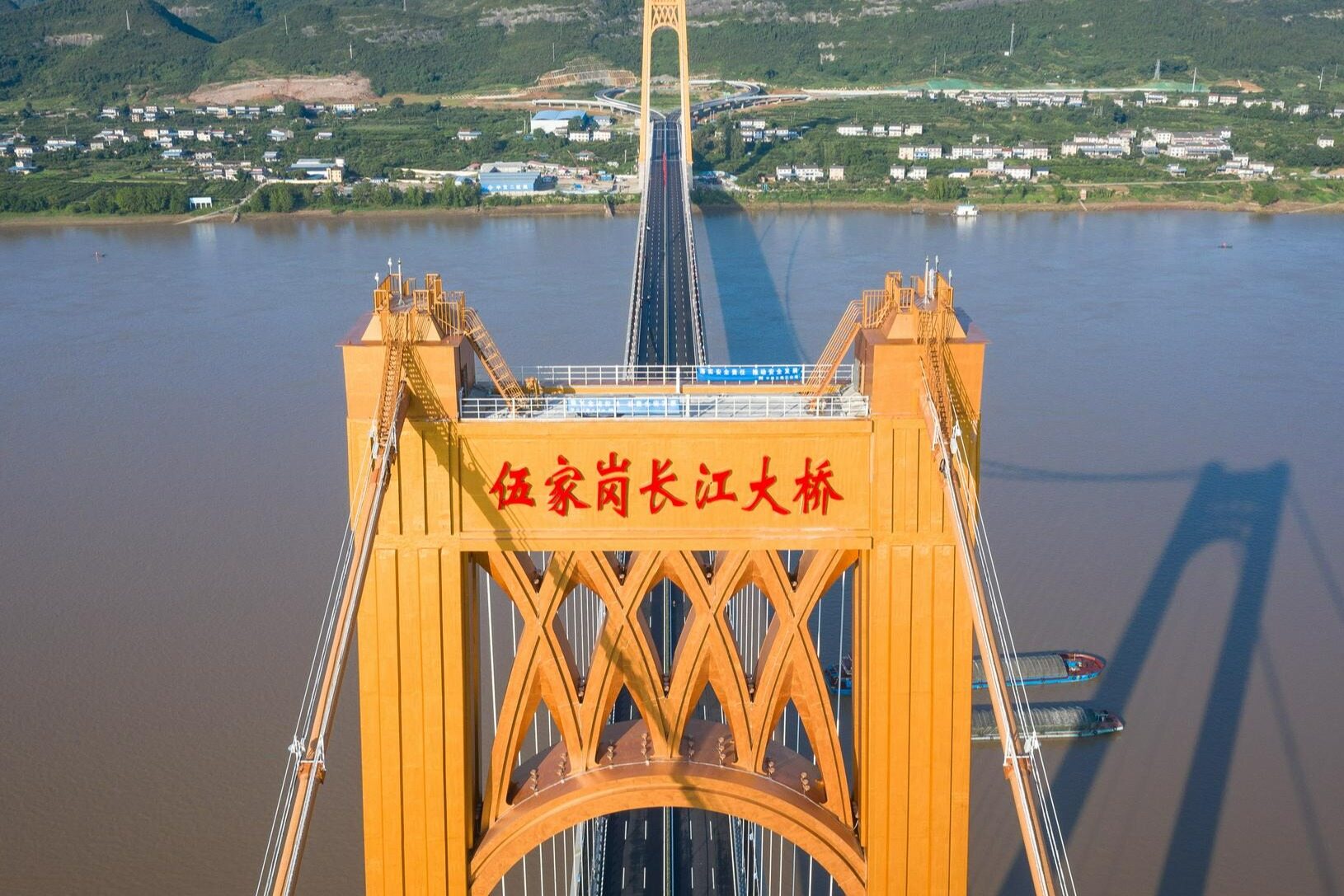
Crossing the Yangtze River is no longer one or two times. How to build bridges across the river safely and energy-saving will become the focus of our research! On August 2, 2021, Yichang Wujiagang Yangtze River Bridge was officially opened to traffic. The bridge is one of the 19 river-crossing passages in our province in the "Planning for Comprehensive Three-dimensional Transportation Corridor of the Yangtze River Economic Belt" of the State Council. What are its "sharp eyes" technology? On the eve of the opening of the bridge, Zhou Changdong, the general technical consultant of Wujiagang Yangtze River Bridge, revealed that the bridge produced 12 innovative technologies including tunnel anchors, shallow-buried gravity anchors, and steel box girder two-by-two welding, saving investment costs over 100 million yuan.
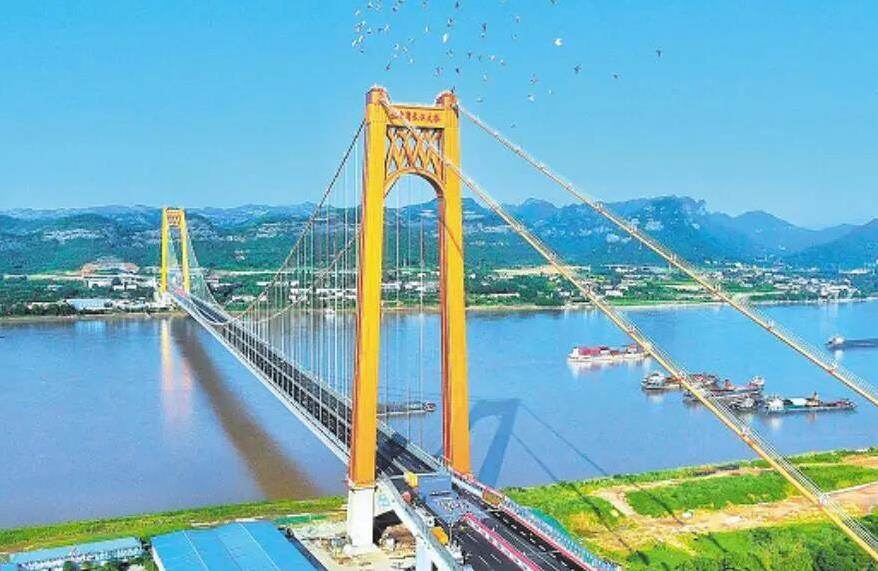
The Wujiagang Yangtze River Bridge has a main span of 1,160 meters. It is designed as a steel box girder suspension bridge for the main bridge. There are 77 steel box girder sections, each of which is 15 meters long. "The hoisting of the steel box girder of the main bridge is a worldwide problem in the construction of suspension bridges." Zhou Changdong said that in the past, the common practice in the world was that workers first hoist all the steel box girder to the bridge deck section by section, and then use technical means to "linear leveling". "After that, unified welding. "This method of construction takes a long time and is relatively inefficient." "Innovation is forced out." Zhou Changdong said with a smile. Faced with time constraints and cost pressures, he creatively proposed the two-by-two welding technology for the steel box girder of the main bridge: first weld the steel box girder on the ground to "combine the two into one", and then hoist the 30-meter-long assembly to The bridge deck is hoisted and welded at the same time. At the beginning, some experts believed that the technology was risky. If the angle of the steel box girder is not uniform, it is likely to be "torn apart" by high winds. After the theoretical analysis of Southwest Jiaotong University and a large number of scientific experiments, the technology meets the design requirements and was successfully used on the Wujiagang Yangtze River Bridge. The main bridge steel box girder hoisting time was two months less than the original plan. It has been recognized by multiple authorities that this "forced out" steel box girder pairwise welding technology is the world's first.
The most difficult tunnel anchor on the Yangtze River
On July 30, the straight deck of the Wujiagang Yangtze River Bridge passed through the mountain like a sharp sword, and the two main cables plunged into the mountain. The main cable of Wujiagang Yangtze River Bridge is the main load-bearing component of the bridge, and each main cable weighs 5,000 tons. According to Zhou Changdong, other bridges were constructed by digging deep underground to build anchors. The main steel cables are connected and fixed with the anchors, which are called "gravity anchors" in the industry. When the Wujiagang Yangtze River Bridge started, there happened to be a mountain at the north bank of the bridge. If you use traditional methods to remove this mountain shift, blasting is required, which not only pollutes the environment, but also where the more than 300,000 earthwork is stacked is also a problem. "The mountain is a natural gravity anchor. Why don't we use the weight of the mountain to hold the main cable of the bridge?" In 2017, at the beginning of the construction of the bridge, Zhou Changdong was thinking about finding a "shortcut": Can we build a tunnel anchor without moving the mountain? After countless attempts, the simulation experiment was finally successful. The data shows that the bearing capacity of the anchor plug body of the tunnel anchor is 6 times the tension of the main cable of the bridge. Innovation has changed from conception to reality. During the construction process, the workers dug a 101-meter-long tunnel in the mountain, and then slipped an anchor body weighing more than 20 tons into the tunnel through special equipment to form a huge tunnel anchor. Zhou Changdong told reporters that this is the first time a tunnel anchor has been used on the soft rock by the Yangtze River for a kilometer-long bridge, and it is also the most difficult tunnel anchor.
More than 20,000 cement pillars "planted" underground
The geology of the south bank of the Wujiagang Yangtze River Bridge is special. The rock layer is only formed by digging down more than 30 meters, and most of it is a soft sand and pebble layer, which is also connected to the Yangtze River water. root".
Keywords: engineering news, engineering construction information
Zhou Changdong proposed "shallow buried gravity anchor technology". In a circular foundation pit with a diameter of about 85 meters, more than 20,000 small holes were drilled 15 meters underground, each with a diameter ranging from 5 cm to 10 cm, to squeeze out the water in the sand egg layer; Concrete slurry was injected into each small hole, and more than 1,600 tons were injected. After the concrete is solidified, more than 20,000 small holes become concrete pillars, which are "planted" underground like tree stumps, turning loose "tofu" into "stones", laying a solid foundation for the construction of the pile foundation on the south bank of the bridge. "A Yangtze River Bridge is an integration of many innovative technologies." Zhou Changdong told reporters that the bridge is the first in China to use cable strand hybrid technology of different thicknesses, making each cable strand tighter and the main cable infinitely close to a circle. The main cable consists of 85 strands of 127 wires and 6 strands of 91 wires. The length of a single strand is about 1995 meters. In the end, 91 strands composed of 11341 steel wires constitute a main cable weighing about 5,000 tons, which can withstand an ultimate tensile force of 60,000 tons.Editor/Xing Wentao
Comment





 Praise
 Collect
 Comment

 Share
Share


Write something~