 Search


- With an investment of 3.8 billion yuan and 115000 seats, the world's largest football stadium is rising in Africa
- Morocco is not just building a World Cup stadium. This is a symbol of the leap in Africa's sports infrastructure and a perfect
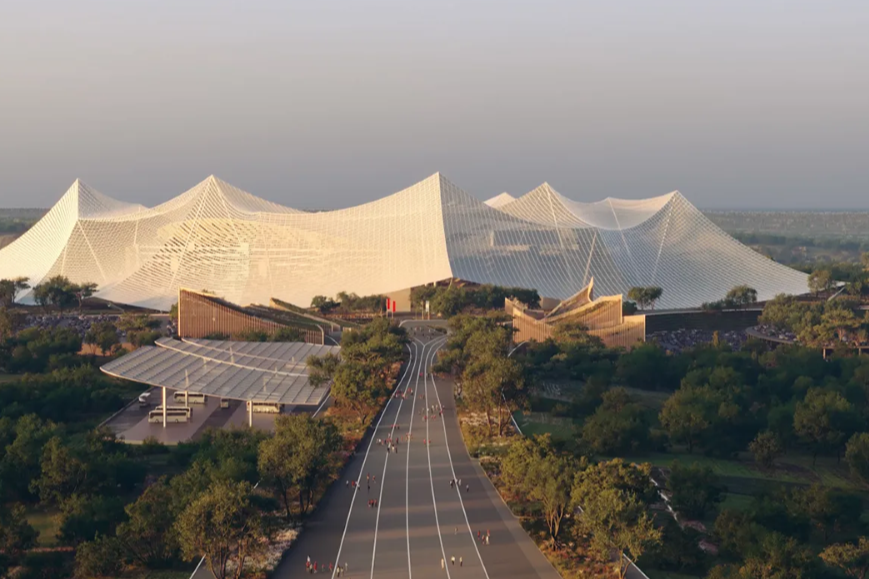
About 38 kilometers north of the Moroccan city of Casablanca, a magnificent landmark symbolizing African ambition is rising from the ground. The Hassan II Stadium, with a total investment of approximately 3.8 billion yuan and a capacity of 115000 people, has been progressing at full speed since construction began in August 2024 and is scheduled to be fully completed by the end of 2028. It will not only be the core venue for the 2030 World Cup co hosted by Morocco, Spain, and Portugal, but also redefine Africa's position in the global sports landscape as the world's largest football stadium.
Dialogue between Traditional Tents and Modern Engineering
The design scheme for Hassan II Stadium originated from a fierce international competition, ultimately won by the Paris based Oualalou+Choi agency in collaboration with the world's top sports architecture company Populous. This innovative design not only allows natural light to gently diffuse into the venue, but also outlines highly recognizable contours on the skyline. The roof is supported by a circular structure consisting of 32 staircases, serving as an entrance and creating a lush sky garden at a height of 28 meters.
A multifunctional complex beyond the arena
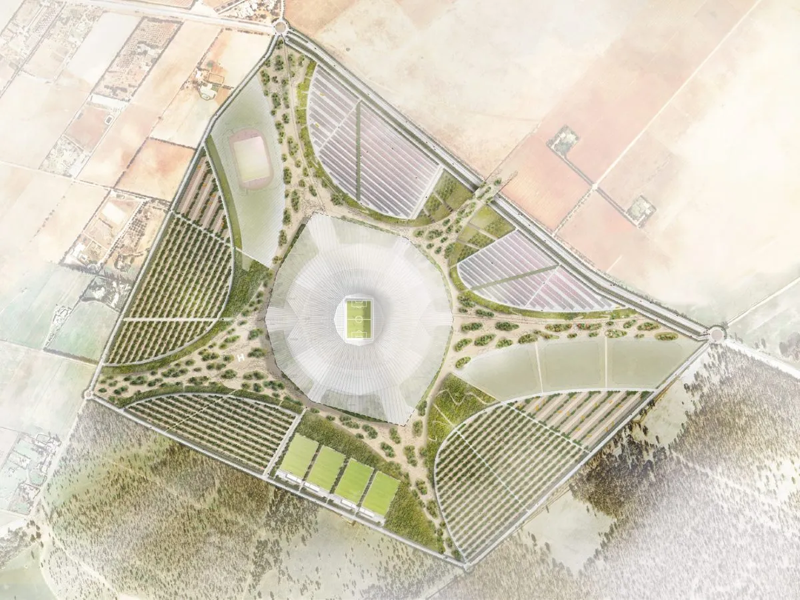
As a future oriented super sports stadium, its functions go far beyond hosting events. There are three high-density stands designed on both sides of the stadium, which can accommodate 29500 ordinary spectators on each side, creating a lively home atmosphere together. The venue also features royal private rooms and a five story VIP reception area, providing high-end services for a total of 12000 VIPs. To cope with the huge passenger flow, the project has simultaneously upgraded the surrounding highways, railways, and public transportation network extending from Casablanca. In addition, the entire 100 hectare plan also includes hotels, commercial areas, training grounds, large parking lots, and conference facilities, aiming to create a new urban landmark that integrates sports, commerce, and leisure.
Carrying the World Cup and the Future of African Sports
This stadium, named after King Hassan II, who reigned from 1961 to 1999, aims to commemorate his contributions to the Moroccan sports industry. Its construction is timely and has been officially designated as an important venue for the 2030 World Cup. At that time, it will serve as the permanent home ground for the Moroccan national team and the two major Casablanca clubs, Raja and Vidad. The birth of this venue is not only to welcome a world-class football feast, but also a powerful declaration for Morocco and even Africa to showcase its development vitality, cultural confidence, and ability to host international top-level events to the world. Keywords: Southeast Asian Engineering Information Network, Overseas Engineering Construction
From integrating traditional and modern design concepts to carrying the era mission of intercontinental glory, every inch of the construction of Hassan II Stadium is writing history. It is not only a concrete and steel structure, but also a concrete embodiment of a country's and a continent's sports dreams and cultural confidence. When it is fully presented to the world in 2028, the horizon of Casablanca will be permanently changed. Editor/Yang Beihua
Comment



 Praise
 Collect
 Comment

 Share
Share


Write something~