 Search


- From Market Leadership to Technology Leadership: RADAR Reshapes the New Energy Pickup Era
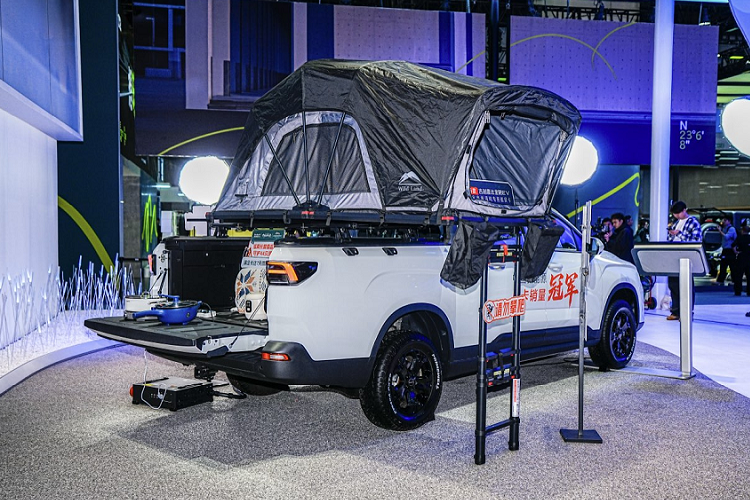
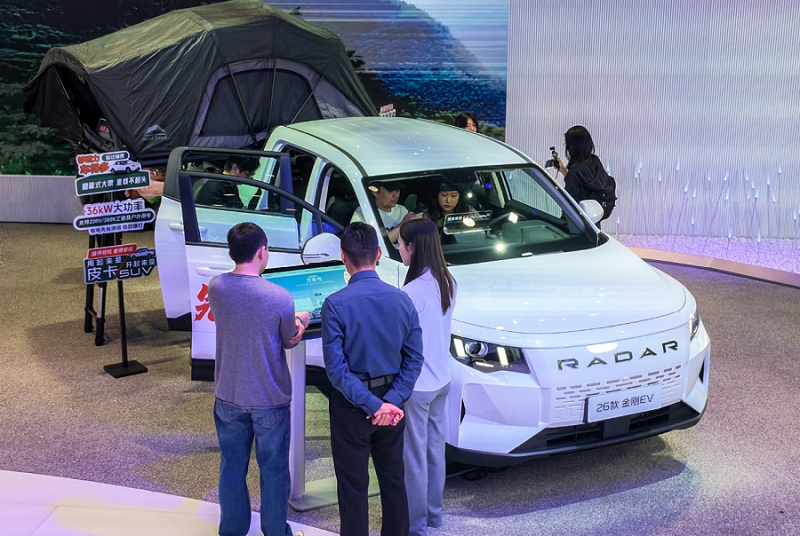
After four consecutive years as sales champion, RADAR advances again, bringing the 2026 RADAR King Kong EV to the Guangzhou Auto Show. On November 27, the 2026 Guangzhou International Automobile Exhibition officially opened. Having held the No. 1 position in China’s new energy pickup sales for four consecutive years and steadily entered the top four among all pickup categories, RADAR is showcasing not merely the specifications of a new model, but its systemic capability to move new energy pickups from “category substitution” toward “value reconstruction.” The booth is designed around the concept of “public-welfare guardianship,” recreating last year’s field research and patrol scenes of guardians in Hainan Tropical Rainforest National Park.
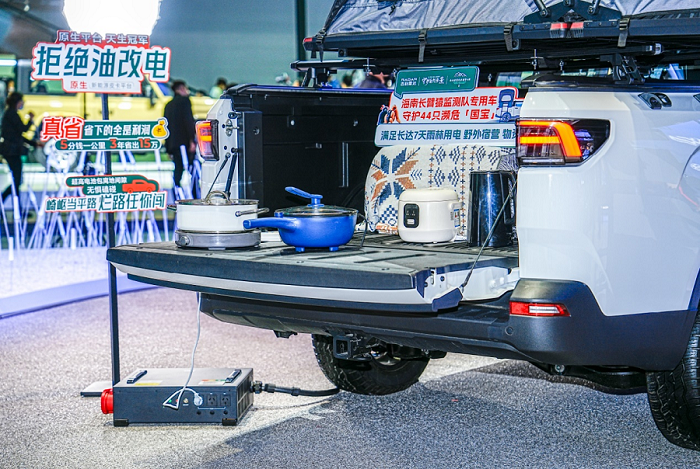
Last year, RADAR joined the Bawangling Branch of Hainan Tropical Rainforest National Park to enter the rainforest and protect the endangered gibbon with zero carbon. For up to seven days, the team stayed deep in the field to carry out guardianship operations. Relying on 36 kW high-power silent external discharge, the vehicle provided stable power for tent lighting, communication equipment, electric cookers, and scientific research instruments. With zero emissions and low noise, it minimized disturbance to the rainforest environment and helped protect the peaceful habitats of gibbons and other wild animals and plants. At the auto show, through a scenario-based display featuring a Qingzhou tent and high-power household appliances in the truck bed, visitors can intuitively experience RADAR’s native platform, safety quality, and all-scenario power supply technology, and understand the brand philosophy of “technology for good and ecological guardianship.”
After the Sales Championship, New Energy Pickup Competition Enters the “System Capability” Stage
In China’s pickup market, electrification is not a multiple-choice question but an ongoing replacement. In the past, the pickup market featured a “coexistence of multiple strong players,” with fuel and electric models each holding their own ground. Today, this landscape has been rewritten by one company.
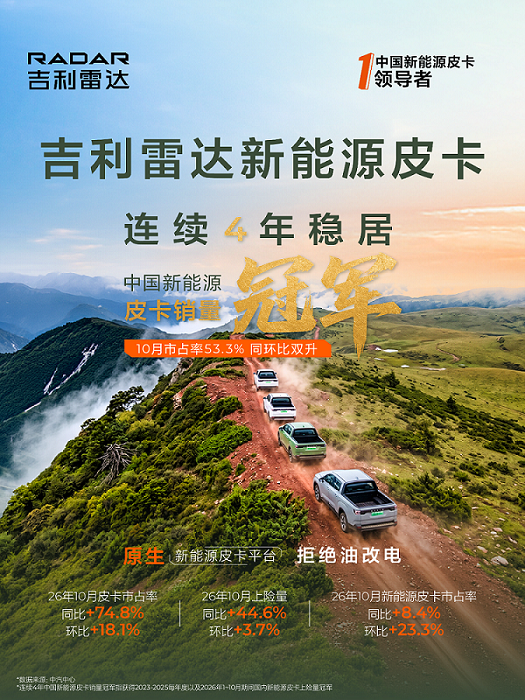
As the only new energy pickup brand under its parent group, RADAR has held the No. 1 position in China’s new energy pickup sales for four consecutive years. In October 2026, RADAR’s insurance registrations rose 44.6% year on year and 3.7% month on month, achieving a 53.3% market share in new energy pickups and a 73.7% share in pure electric pickups. Against the backdrop of declining sales at leading pickup brands such as Great Wall and JMC, RADAR was the only brand to achieve both year-on-year and month-on-month growth. From leading the new energy pickup segment to ranking among the top four in all pickup categories, RADAR is changing the traditional pickup market’s pattern of “coexistence of multiple strong players.”
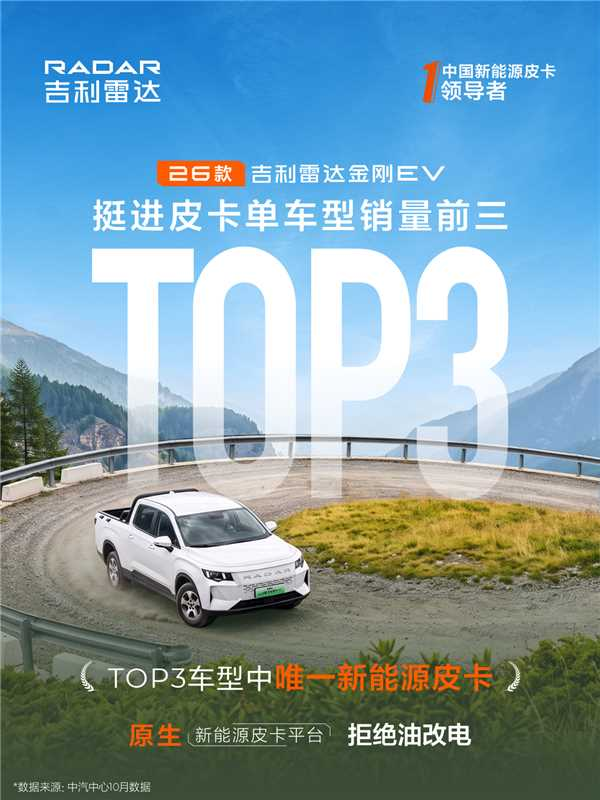
This shift in the market structure is reflected more directly in its core product: as the key model at this auto show, the 2026 RADAR King Kong EV, since its launch in April, has leveraged its “commercial-passenger versatility” to enter the top three pickup models by sales in October. It is also the only new energy pickup among the top three in the all-category ranking. This not only demonstrates the electrification trend in pickups but also marks its successful entry into the heartland of the fuel vehicle market, making it a key force driving the reshaping of the industry landscape.
But sales figures are only the surface. The deeper change is that new energy pickups represented by RADAR are transforming from “exclusive tools” for specific industries into “productivity equipment” for a broader range of entrepreneurs. Take the Guangdong market as an example: construction engineering, processing and manufacturing, plant-protection drones, agriculture, forestry, animal husbandry and fishery, and municipal infrastructure projects constitute real, high-frequency use scenarios for pickups. These scenarios do not impose a single requirement: vehicles must be able to carry equipment and work on construction sites while also supporting daily commuting and family travel; they must offer clearly calculable per-kilometer costs while withstanding high-intensity work. Only those who can respond to these compound needs with systemic product capability can truly push new energy pickups from “policy-driven” to “value-driven.”
The Hardcore Foundation: A Native Platform and Passenger-Car-Level Safety System
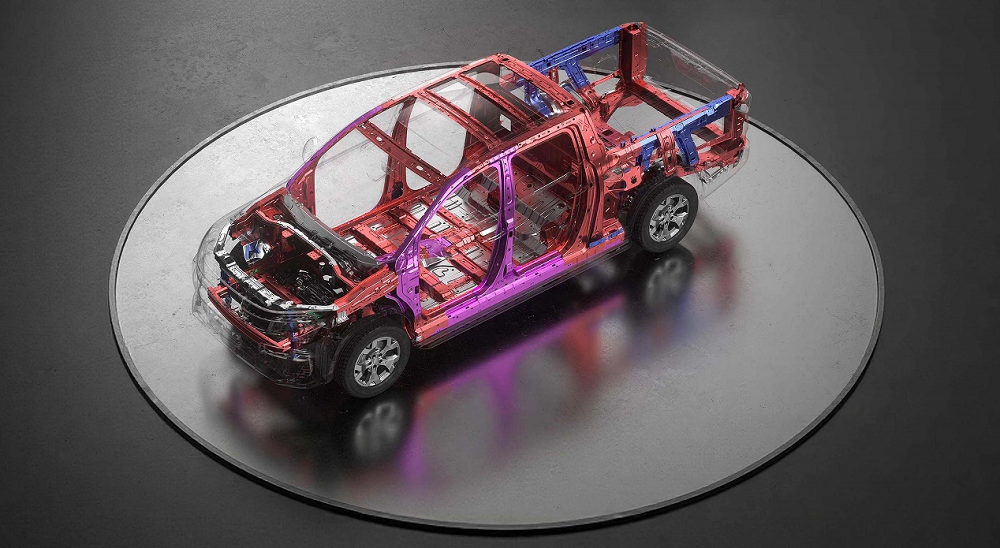
The product logic of the 2026 RADAR King Kong EV is first built on platform and safety. RADAR fully applies the group’s three-electric technology system and supply chain resources, using a native new energy pickup platform that is distinct from traditional fuel pickups and “converted-from-ICE” pickups. This underlying difference determines the vehicle’s upper limits in spatial layout, chassis structure, battery safety, and overall reliability.
In terms of body structure, the 2026 RADAR King Kong EV adopts an integrated body structure with a hidden ladder frame, embedding two main longitudinal beams into a cage-type body frame. With 70% high-strength steel and a three-dimensional force-transfer structure, the body’s torsional rigidity reaches 30,300 N·m/deg, nearly 10 times that of traditional pickups. The direct value is clear: no front-end lift under heavy loads, a cargo bed less prone to deformation, greater stability when carrying equipment and building materials on construction sites, and more solid climbing on rough roads. At the same time, the built-in frame design avoids the pain point of a traditional ladder frame intruding into underbody space. A 253 mm ultra-high ground clearance provides better chassis passability and leaves a safe location for the battery pack, balancing heavy-load capability, chassis passability, and three-electric safety.
In areas users cannot see, RADAR upholds the group’s all-domain safety philosophy and builds a quality benchmark for the pickup segment with a passenger-car-level safety system. Brand users have accumulated more than 1 billion kilometers of driving mileage, and there are real-world data points such as users driving more than 500,000 kilometers in three years with no repairs to core components, verifying the product’s fundamental qualities of “all-domain safety and reliable quality.” For a pickup that participates in production operations, safety is not a bonus item on the specification sheet but the baseline that determines uptime, operating costs, and user trust.
The Essence of Commercial-Passenger Versatility: Turning a Pickup from a “Transport Tool” into “Mobile Productivity”
The most readily perceived product label of the 2026 RADAR King Kong EV is all-scenario external discharge. The vehicle has 36 kW high-power external discharge capability and supports 220V/380V industrial and outdoor discharge with plug-and-play operation, basically meeting the power needs of outdoor operations and leisure. Its electricity cost is only one-eighth that of a fuel generator, and it is quiet and comfortable. It supports multiple scenarios such as charging while discharging, discharge while driving, discharge while parked, discharge with the vehicle locked, and remote discharge control, truly achieving “power wherever the vehicle goes.”
This gives it different roles in different communities: for the construction machinery sector, it is an “outdoor mobile work station” that can simultaneously support high-energy-consumption equipment such as high-power electric welders and cutting machines; for the drone logistics/lifting sector, it is a “mobile energy station in fields and forests” that can carry two drones and an 800 L water tank in one trip, fully charge two drone batteries in 8 minutes, and continue operating at 40°C. Equipped with the same Flyme Auto 2.3 intelligent cockpit as Lynk & Co, a 14.6-inch high-definition central control screen, all-scenario “visible and speakable” voice control, scheduled charging, and other functions, the 2026 RADAR King Kong EV offers an intelligent and comfortable experience closer to a passenger vehicle in addition to its ability to “get work done.” Commercial-passenger versatility is not a simple stacking of configurations; it means the same vehicle participates in production on workdays and carries life on weekends.
On this basis, RADAR also launched the RADAR King Kong EV Chuangfu Jingang 370 km, positioned as an RMB 100,000-class all-electric pickup for wealth creation, with a starting price as low as RMB 109,800. Its significance lies in further lowering the threshold for using new energy pickups, enabling individual business owners, small and micro entrepreneurs, and family operation users to enter the value range of new energy pickups at a lower cost. From an “exclusive tool” for specific industries to a “standard configuration” for mass entrepreneurship, the boundaries of new energy pickups are being redrawn.
Guangzhou Auto Show: How RADAR King Kong EV Makes “Commercial-Passenger Versatility” the Standard Answer
From November 27 to December 6, at the RADAR booth in the China Import and Export Fair Complex, Guangzhou. The 2026 RADAR King Kong EV is meeting users here. Inspired by the public-welfare guardianship scene in Hainan Tropical Rainforest National Park, the booth features an experience area with a Qingzhou tent and high-power household appliances in the truck bed. Visitors are welcome to experience it.
When a pickup is no longer just a pickup but a kind of “mobile productivity infrastructure” integrated into thousands of industries and serving millions of households, competition in new energy pickups is no longer about the success or failure of a single model, but a comprehensive contest of platform, technology, safety, scenarios, and user reputation. From public-welfare guardianship in the rainforest to entrepreneurial work sites, after four consecutive years as sales champion, what RADAR truly needs to prove is whether it can transform its leading advantage into a sustainable systemic capability. What is a truly hardcore King Kong, and what is commercial-passenger versatility? At the Guangzhou Auto Show, the answer will speak for itself.
Comment

 Praise
 Collect
 Comment

 Share


Write something~