 Search


- The Shenzhen metropolitan area plans to start construction of 10 intercity railway projects by 2022
- The total construction mileage is about 351 kilometers, and the total investment is about 187.2 billion yuan
Recently, the first meeting of the Shenzhen Metropolitan Area Intercity Railway Project Construction Headquarters jointly held by Shenzhen, Dongguan and Huizhou was held in Shenzhen. The meeting jointly studied and promoted the construction of the inter-city railway in the Shenzhen metropolitan area. It was clarified that the Qianhai-Huanggang port section of the Guangzhou-Dongguan-Shenzhen intercity will start construction in 2021, and the Qianhai-Ping area of the Shenzhen-Huizhou intercity free trade zone will start before the end of 2022 .
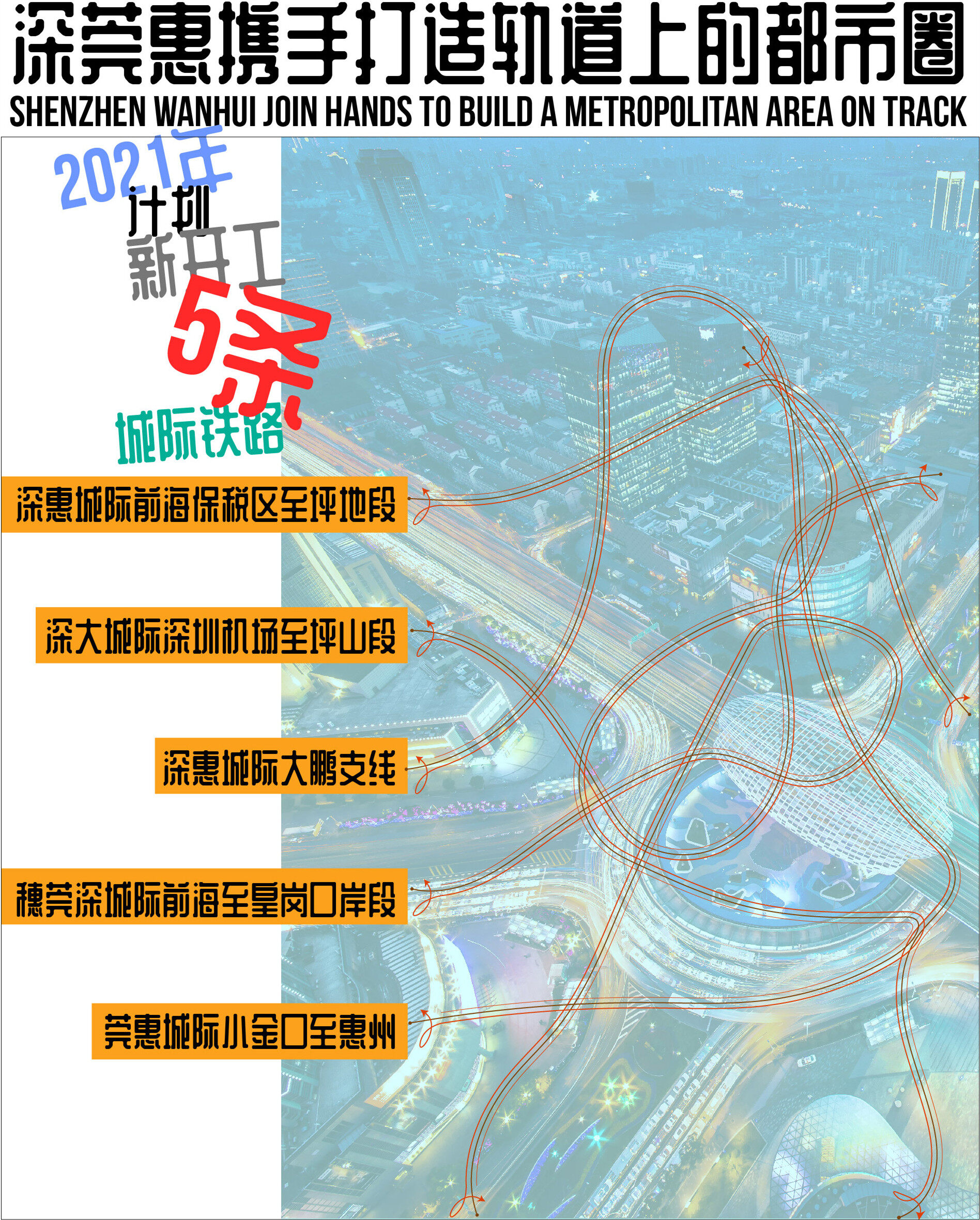
The meeting made it clear that 10 intercity railway projects are planned to be started by the end of 2022, namely:
Shenhui Intercity Qianhai Free Trade Zone to Pingdi Section
Shenhui Intercity Pingdi to Zhongkai West Section
Shenhui Intercity Zhongkaixi to Huicheng South Section
Shenhui Intercity Dapeng Branch
Shenzhen University Intercity Shenzhen Airport to Pingshan Section
Guangzhou-Dongguan-Shenzhen Intercity Shenzhen Airport to Qianhai Section (Construction has started)
From Qianhai to Huanggang Port between Sui-Dongguan-Shenzhen Intercity
Intercity between Tangxia and Longgang
Changping to Longhua Intercity
Guanhui Intercity Xiaojinkou to Huizhou North Section
The above 10 intercity railway projects have a total construction mileage of about 351 kilometers and a total investment of about 187.2 billion yuan. Except for the Guanhui intercity Xiaojinkou to Huizhou north section, the remaining 9 new projects are planned to be led by Shenzhen.
Plan to start 5 projects during the year
Shenzhen-Huizhou Intercity Qianhai to Pingdi Section: The route starts at Qianhai, Shenzhen, passes through Xili, Shenzhen North, Wuhe, Pinghu, Dongguan Fenggang, and Longgang, and ends at Pingdi. The total length of the route is about 58.8 kilometers, with 11 stations. seat.
Shenzhen University Intercity Shenzhen Airport to Pingshan section: The line starts at Shenzhen Airport T4 hub station, passes through Shiyan, Longsheng, Wuhe, Bainikeng, Dayun, Pingshan, and ends at Julong. The line is about 69 kilometers long. 11 stations.
Shenhui Intercity Dapeng Branch Line: The line starts at Longgang Longcheng, passes through Pingshan and Kuiyong, and ends at Dapeng Xinda Station. The line is about 39.5 kilometers long and has 6 stations.
The Guangzhou-Dongguan-Shenzhen Intercity Qianhai to Huanggang Port: The line starts at the Guangzhou-Dongguan-Shenzhen Intercity Qianhai Station (excluding), passes through Qianhai, Nanshan, and Futian, and ends at Huanggang Port Station. The main line is about 20.5 kilometers long. Set up 2 stations.
Guanhui Intercity Xiaojinkou to Huizhou North Section: The Guanhui Intercity Xiaojinkou to Huizhou North Section is an extension of the Guanhui Intercity Line, which leads from the north end of the existing Guanhui Intercity Xiaojinkou Station, with a total length of about 6.36 kilometers. The engineering construction standard is the intercity railway, with a design speed of 200 km/h, and a speed limit of 160 km/h in the underground section.
It is understood that the construction of the intercity railway in the Shenzhen metropolitan area is an important measure to integrate the metropolitan area, radiate the Pearl River Delta, and smooth the domestic cycle. It is also an inevitable requirement for the high-quality construction of the Guangdong-Hong Kong-Macao Greater Bay Area and the first demonstration zone. Next, Shenzhen will do a good job of taking the lead and, in accordance with the inter-city project coordination mechanism determined at this meeting, coordinate and promote the planning, design, construction, operation, and management of the intercity railway network in the Shenzhen metropolitan area. At the same time, the two cities of Dongguan and Hui will advance the planning and construction of the inter-city railway in the Shenzhen metropolitan area, jointly promote the optimization of the rail transit network in the Greater Bay Area, accelerate the construction of inter-city lines, and promote the research on the public transportation operation of the inter-city railway, so as to meet the main requirements of the Greater Bay Area. The travel needs of the "1 hour commute circle" between cities are quickly accessible. Editor/He Yuting
Comment


 Praise
 Collect
 Comment

 Share
Share


Write something~