 Search


- This project is not only a transportation channel crossing the Paraguay River, but also a catalyst for regional coordinated development
- The planning and construction of the Pilar Kano Bridge marks a new stage of South American regional entity integration driven by strategic infrastructure connectivity

On the geographical map of South America, the Paraguay River is like a winding lifeline, nourishing the land on both sides but also forming a natural transportation barrier. For Paraguay, which is located inland, breaking through river barriers and establishing stable connections with neighboring countries is the strategic core of national development. Now, a major infrastructure project codenamed the Pilar Kano Cross border Bridge is moving from blueprint to reality. The bridge connecting Pilar City in Paraguay and Cano Port in Colonia, Argentina in this plan is not just an ordinary transportation project, but a systematic project that integrates geopolitical strategy, cutting-edge engineering, and regional economic integration.

Technical parameters and systematic design
This project is located on a critical section of the Paraguay River, and its design faces complex technical challenges. The bridge must meet the navigation requirements of 3000 ton ships, with a designed net width of no less than 150 meters and a net height exceeding 30 meters for the main navigation opening. Structurally, after comparing multiple options, the cable-stayed bridge scheme with a main span of 320 meters won due to its excellent traffic capacity, seismic performance (designed with a peak acceleration of 0.25g), and compatibility with local engineering experience. Although the total length of the project (including the approach bridge) is yet to be finalized, its design has strictly followed the highest bridge standards in South America, with axle load standards reaching HS-25 level to ensure durability and safety for a hundred year life cycle.
The progress of the project is based on clear phased planning. After the signing of the memorandum of cooperation between the two heads of state on December 6, 2022, the project immediately entered the practical stage. At present, the project is in the preliminary research and design stage funded by the Development Bank of Latin America and the Caribbean (CAF), and key hydrogeological surveys and traffic flow modeling are underway. According to the plan, the project will undergo international design bidding in the third quarter of 2024 and strive to start the construction of the main structure in 2026.
Macro strategy beyond bridges
The profound significance of the Pilar Kano Bridge lies in its role as a key piece in the regional macro strategic puzzle. It is not only the connecting point between two towns, but also the core branch of the ambitious logistics artery of the bio ocean corridor extending eastward. The corridor aims to construct a land route from Brazil through Paraguay and Argentina to Chilean Pacific ports. The bio ocean bridge connecting Brazil and Paraguay, which is advancing in parallel, has been completed by over 80% and is expected to be completed by February 2026. The future completion of the Pilar Kano Bridge will form a network effect with these projects, completely reshaping the logistics path and economic geography of the Southern Cone region.
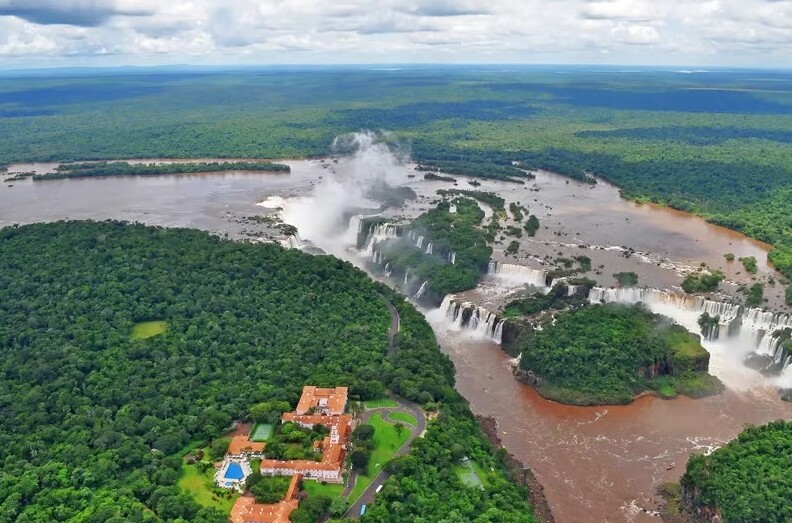
At the local level, the bridge is positioned as an engine for regional transformation. Deep coordination between engineering planning and the newly built industrial zone, flood control, and highway upgrading projects in Pilar city. Its goal is to transform Pilar from a border historic town occasionally affected by floods to a modern hub that integrates industry, commerce, and tourism. The connecting line on the Argentine side will directly connect to the national trunk highway to ensure channel efficiency.
Practice of Modern Engineering Management
To manage this complex cross-border project, a multi-level management system has been established and innovative technologies have been introduced. The decision-making level is composed of a joint committee composed of the transportation ministers of the two countries, while the executive level is led by the Paraguayan Ministry of Public Works and Communications (MOPC) and supervised by an independent international supervision team hired by CAF. The construction plan widely applies the Building Information Modeling (BIM) 5D management system, integrating unmanned aerial vehicle aerial surveying, prestressed sensor network, and blockchain building materials traceability system, to achieve digital management of the entire life cycle from design, construction to future maintenance. Keywords: traffic news, international news and information, international news website
From political consensus to technological exploration, the Pilar Kano Bridge project is steadily advancing. It embodies the typical characteristics of modern large-scale infrastructure engineering: not only the integration of technology, but also the carrier of strategy. For Paraguay, it is another lifeline that breaks through the limitations of a landlocked country and leads to the ocean; For the region, it is a solid lever for promoting physical integration and supply chain reshaping in South America.Editor/Cheng Liting
Comment





 Praise
 Collect
 Comment

 Share
Share


Write something~