 Search


- The total length is 390.327 kilometers, with a total investment of 95.1 billion yuan and a design speed of 350 kilometers per hour
2026 is destined to be the ice breaking year in the history of the Guangqingyong high-speed railway.
In the latest release of the "Top Ten Major Tasks for Overcoming Difficulties in the City of Qingyuan, Guangdong in 2026", this railway is no longer just a paper plan, but is listed as the top seed for major project breakthroughs. What is even more exciting is the rigid constraint of the schedule: the feasibility study approval must be completed in the second quarter, and construction must officially begin before the end of October.
It should be noted that in the recent 14th Five Year Plan for railway development, it was only a research project in the early stage of investigation. According to industry conventions, such projects often require years or even ten years of lengthy argumentation, and many similar projects ultimately end up focusing on research. But the Guangqingyong high-speed railway has broken this curse - from the launch of survey and design by China Railway Group in 2024 to the current rush to start construction, its speed of advancement is comparable to the speed of high-speed rail itself.
From inter provincial negotiation to same frequency resonance
The accelerated awakening of this steel dragon is due to a rare resonance of the same frequency in Guangdong and Hunan provinces.
Opening the list of key projects and government work reports for the two provinces in 2026, the existence of the Guangqingyong high-speed railway is extremely strong. In Guangdong, this is the fifth consecutive year that the project has been included in the government work report, but the wording has undergone a historical change - from the previous promotion of preliminary work to the start of construction. The weight of these four words means that all obstacles in the early stages of the project have been cleared, and funds, land, and approvals are all in place.
In Hunan, this enthusiasm is equally high. At the beginning of the year work conference, the Hunan Provincial Development and Reform Commission directly called for full efforts to promote the construction of the Yongqing Guangzhou high-speed railway as soon as possible in 2026. It undoubtedly occupies a place in the list of key construction projects in Hunan Province.
This is not only the connection of transportation lines, but also the forced stitching of the economic map between the two provinces. Guangzhou has included it in the core task of urban agglomeration and urbanization development, aiming to strengthen the radiating ability of the core hub of the Greater Bay Area to the north through the seamless connection of Guangzhou North Station; Hunan, on the other hand, sees it as a lifeline connecting the southern Hunan region with the Greater Bay Area, attempting to break through geographical barriers.
95.1 billion strategic ambition
Why is the country willing to invest 95.1 billion yuan in real money for this railway? The answer lies in the layout of the national macro road network.
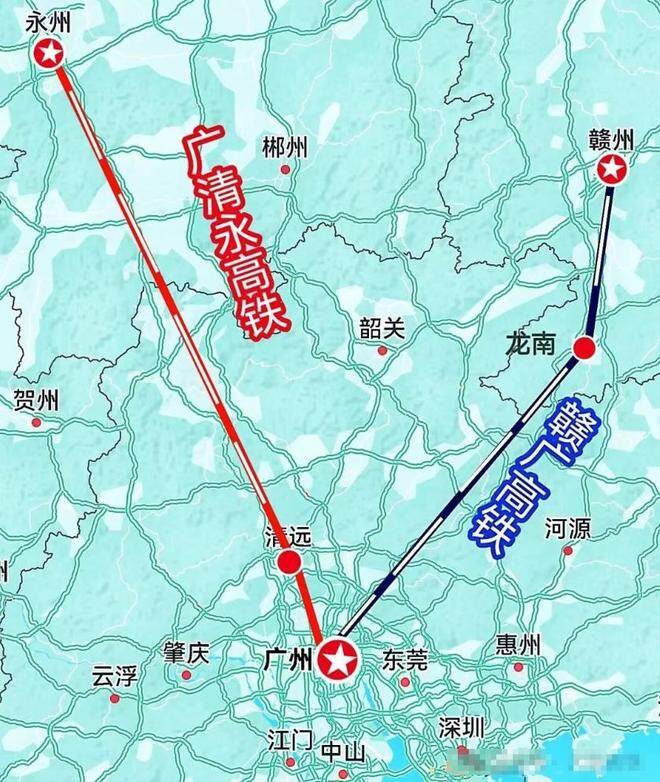
The Guangqingyong high-speed railway has a total length of 390.327 kilometers (232.902 kilometers in Guangdong and 157.425 kilometers in Hunan), with a designed speed of 350 kilometers per hour. It is not only an auxiliary channel of the Beijing Guangzhou high-speed railway, but also known as the second channel of Beijing Guangzhou.
Background deep reading
At present, the Beijing Guangzhou high-speed railway is approaching capacity saturation, especially the Wuhan Guangzhou section, which operates at high load all year round. The emergence of the Guangqingyong high-speed railway is equivalent to building a diversion channel next to the major arteries in Beijing. It is connected to the Hunan South High Speed Railway to the north and the Guangzhou Shenzhen Hong Kong High Speed Railway to the south, and is a key pillar of the Guangdong Hong Kong Macao Chengdu Chongqing main axis in the national eight vertical and eight horizontal high-speed railway network. In the future, in addition to taking the existing Beijing Guangzhou line, Guangzhou to Chongqing can also be directly connected through Yongzhou and Huaihua, forming a high-speed rail dual route from the Greater Bay Area to the Chengdu Chongqing region.
The specific anatomy of the Steel Dragon
The planning details of this railway reveal strong practicality and precision:
Direction: Starting from Guangzhou North Station, heading north through Qingxin District, Yangshan County, and Lianzhou City in Qingyuan, entering Hunan and passing through Lanshan, Ningyuan, Shuangpai, and finally arriving at Yongzhou Station.
Stations: 10 stations will be established along the entire line (Yongzhou, Lingling, Shuangpai East, Ningyuan, Lanshan, Lianzhou, Yangshan, Jintan, Qingyuan West, Guangzhou North), and a new Guangzhou North EMU Depot will be built near Shipi Village in Huadu District.
Progress: As early as May 2025, the project had already passed the feasibility study review. In January 2026, China Railway Fourth Engineering Group Co., Ltd. has issued a tender for location survey geophysical exploration and drilling services; The Hunan section has quickly launched the bidding for environmental impact assessment and soil and water conservation plans. The acceleration of preliminary work directly indicates that the start of work in October is not an exaggeration.
The rewriter of regional economy
For Qingyuan and Hunan Xiangnan, this is not only a path, but also an opportunity to rewrite their destiny.
For Qingyuan: This is a poverty alleviation oriented transportation revolution. The Guangqingyong high-speed railway will put an end to the history of no high-speed railway in the Qingxin and Lianyang areas. Once connected to Guangzhou North Station, the northern area of Qingyuan will be included in the 1.5-hour economic circle of the Greater Bay Area. Imagine chicken head rice from Qingyuan and vegetable hearts from Lianzhou, still in the fields in the morning, appearing on the dining tables of Guangzhou people at noon.
For Hunan: This is the gateway to the southern region of Hunan. Yongzhou, Ningyuan and other places are only over 300 kilometers away from Guangzhou, but due to traffic barriers, they have been in a state of darkness under the lights for a long time. After the high-speed rail is opened, the travel time from Yongzhou, Hunan to Guangzhou will be reduced from the current 5 hours or more to around 1.5 hours. This is not only a time saving measure, but also an accelerator for industrial transfer - the electronic information and intelligent manufacturing industries in the Greater Bay Area will deeply penetrate into the hinterland of Hunan along the railway tracks.
From a small line of text in the 14th Five Year Plan to the drilling machine that is about to roar by 2026, the Guangqingyong high-speed railway has completed the five-year journey of similar projects in two years. Behind this is the urgent need of the country to improve the eight vertical and eight horizontal road networks, and also a bold attempt by Guangdong and Hunan provinces to find new growth poles through infrastructure interconnection under the pressure of economic downturn. Keywords: high-speed rail, railway planning
When this railway is completed and opened to traffic in 2031, it will not only transport passengers, but also the blood of the integration and development of the Greater Bay Area and inland provinces.Editor/Cheng Liting
Comment

 Praise
 Collect
 Comment

 Share
Share


Write something~