 Search


- The North Taihang Mountain Tunnel, which took over a thousand days to construct, has recently been successfully completed
On January 12, 2026, after 1113 days of intense construction, the Xiongxin High speed Railway North Taihang Mountain Tunnel, constructed by China Railway 11th Bureau, was successfully completed, becoming the first 10 kilometer long tunnel to be completed along the entire line. The completion of this tunnel marks the successful opening of the "throat passage" connecting Hebei and Shanxi, laying a solid foundation for the timely opening of the entire Xiongxin high-speed railway.
The Xiongxin high-speed railway is approximately 342 kilometers long and is the first high-speed railway in Shanxi Province with a designed speed of 350 kilometers per hour. As a controlled project along the entire line, the North Taihang Mountain Tunnel has a total length of 12.519 kilometers and is a first-class high-risk tunnel with a maximum burial depth of 600.96 meters and a minimum burial depth of only 20 meters. The tunnel spans across two provinces, Hebei and Shanxi, and crosses the Taihang Mountains. The geological conditions are extremely complex, with various adverse geological conditions such as sudden water and mud influx, rock burst, collapse, and faults. The construction difficulty and risk are extremely high. At the same time, the tunnel passes through Yinhe Mountain Provincial Nature Reserve in Hebei Province, Tianshengqiao National Forest Park, Geopark, and Mount Wutai World Cultural Heritage, Scenic Spot and Geopark in Shanxi Province, putting forward extremely strict requirements for environmental protection and water and soil conservation. To promote construction, the tunnel has three inclined shafts with a total length of 5397 meters, of which the second inclined shaft is 2681 meters long and has a maximum slope of 10.85%, making it the longest and steepest inclined shaft on the entire line, further increasing construction safety risks.
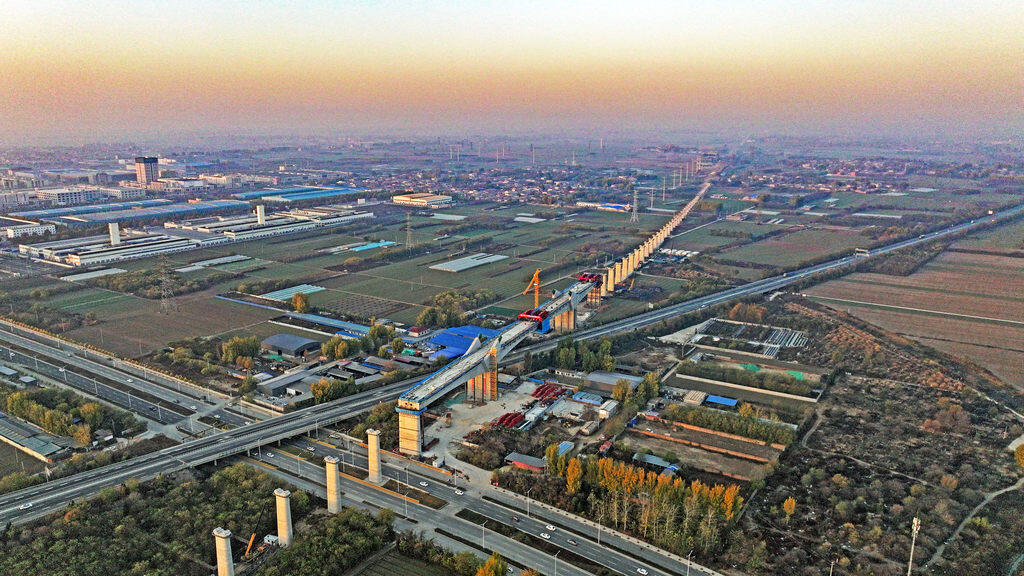
Faced with complex geological and environmental challenges, the construction team adheres to scientific planning, comprehensively uses advanced geological forecasting, monitoring and measurement, advanced support and other technical means, constructs a digital control system, dynamically optimizes support parameters, and introduces safety blocking locks and mobile emergency rescue vehicles to comprehensively ensure construction safety. Through the concept of "ensuring craftsmanship with tooling, ensuring quality with craftsmanship, and ensuring safety with quality", the team promotes the "Five Vehicles and One Bridge" construction method, optimizes construction organization, strengthens work shift management, and closely connects process cycles. At the same time, the active use of intelligent tooling equipment such as hyperbolic arm rock drilling rigs, arch installation machines, secondary lining double-sided panel intelligent rigs, and 3D section scanners has greatly improved construction efficiency and safety management level, ensuring the smooth passage of the tunnel.
In terms of green construction, the construction team has set up sewage treatment plants and sedimentation tanks near each tunnel entrance and mixing station, implemented clean water separation technology, ensured that wastewater is discharged or recycled after treatment to meet standards, and minimized the impact on the surrounding ecological environment.
The Xiongxin high-speed railway is an important component of the Beijing Kunming corridor of the national eight vertical and eight horizontal high-speed railway network. After the completion of the project, it will further improve the national high-speed railway network, significantly enhance the transportation connection between Shanxi and the Beijing Tianjin Hebei region, and have important strategic significance for promoting economic and social development along the line and promoting regional coordinated development.Editor/Cheng Liting
Comment



 Praise
 Collect
 Comment

 Share
Share


Write something~