 Search


- This gap may reshape the global economic landscape, and Chinese enterprises face new opportunities and responsibilities

By 2025, one in every six people worldwide will be using generative AI, but the lowest usage rate in Central Asia is only 6.3%. Experts warn that this phenomenon may aggravate the imbalance of digital infrastructure construction along the the Belt and Road and affect the process of regional scientific and technological innovation cooperation.
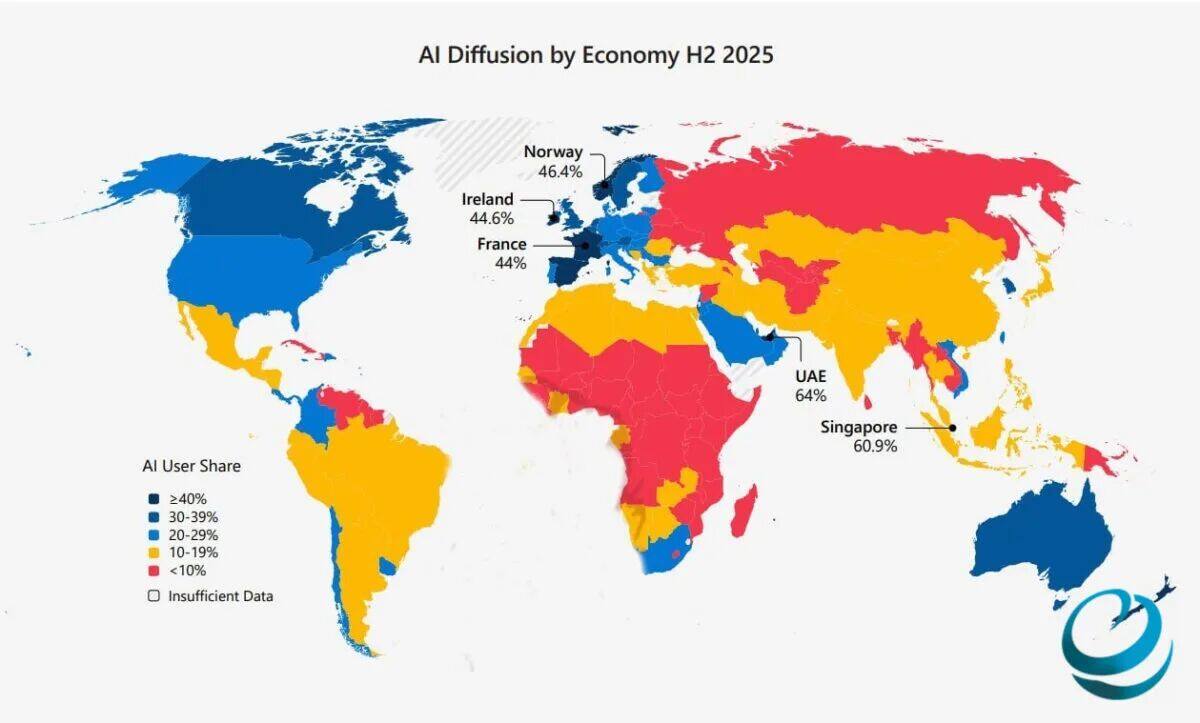
In the smart office in Dubai, UAE, designer Amir gently called on an AI assistant to generate a 3D building model, while rural teacher Gulna from Turkmenistan, 4500 kilometers away, was still using chalk to apply geometric shapes on the blackboard. This digital divide spanning across the Eurasian continent was accurately mapped by Microsoft's January 2025 Global Artificial Intelligence Applications Report - while 64% of the UAE workforce integrates AI tools into their daily work, AI users in Turkmenistan are as scarce as springs in the desert. This report based on telemetry data from global user devices not only presents a technological frontier map from Singapore (60.9%) to Norway (46.4%), but also pushes the lens towards Central Asia: Uzbekistan ranks last in the world with an AI usage rate of 6.3%, while Tajikistan and Turkmenistan have long been trapped in the "tail zone" of digital ratings. Surprisingly, 15.5% of the population in Kyrgyzstan uses generative AI, surpassing neighboring countries such as Kazakhstan and becoming a digital oasis quietly blooming in the desert.

Global AI applications show a fragmented distribution
The report shows that the top ten global AI applications are almost dominated by developed economies: Ireland, France, Spain, New Zealand, the Netherlands, the United Kingdom, and Qatar follow closely behind the United Arab Emirates, Singapore, and Norway. In sharp contrast, Uzbekistan's annual growth rate is only 0.6%, ranking at the bottom of the list alongside Cuba, Afghanistan, and Cambodia. One in every six Earth citizens is a user of generative AI, "Microsoft's chief analyst wrote in a report," but the halo of technological progress has not yet shone into the Central Asian valley. "It is worth noting that the cloud computing center built by Chinese technology companies in Kazakhstan has become a key anchor point for the regional AI ecosystem, and Huawei's assistance in building a smart education platform in Uzbekistan has enabled elementary school students in the country to learn English through voice AI for the first time.
Unexpected breakout in Kyrgyzstan
When the global rating placed Kyrgyzstan (7.6%) behind Madagascar and Mozambique, the data in the second half of 2025 showed a surprising reversal: the utilization rate of generative AI in this country reached 15.5%, not only surpassing Kazakhstan (13.7%) and Türkiye (14.6%), but also equal to the regional highest value Azerbaijan. Through in-depth investigation, it was found that freelancers in Bishkek are using AI to connect with the international design market, while Osh University students use ChatGPT to complete thesis research assistance. Our AI users are mostly in the fields of education, self media, and cross-border freelance work, "revealed the Kyrgyz Minister of Digitalization." It's like desert travelers discovering hidden springs - although they haven't become rivers, they nourish countless individual dreams. "At the same time, the slow progress of Russia (8.0%) and Armenia (6.6%) reflects the deep challenges of digital transformation in the Eurasian Economic Union.

Kazakhstan's' National Track '
Unlike Kyrgyzstan's grassroots infiltration, Kazakhstan has chosen a state led infrastructure path. At Astana Hub Technology Park, engineers are testing an AI judicial judgment assistance system; The smart healthcare platform analyzes CT images of remote areas through image diagnosis; Even the optimization of public transportation routes in the capital has been integrated with machine learning algorithms. We pay more attention to the deep integration of AI with key fields, "said the Deputy Minister of Digital Development of Kazakhstan." Although the user ratio data is not high, AI has been embedded in the capillaries of national governance. ”This strategy echoes China's promotion of the Digital Silk Road: Alibaba's intelligent logistics system, in collaboration with Kazakhstan Post, has increased cross-border parcel sorting efficiency by 200%; Baidu Apollo autonomous driving technology is undergoing extreme cold testing in Nur Sultan. In contrast, Uzbekistan is still in the early stages of building its institutional framework, while Tajikistan is blocked from the AI revolution due to weak power infrastructure and Turkmenistan is subject to strict network regulations.

The Microsoft report is like a digital prism, reflecting two diffusion paths in the AI era: the "universal application model" represented by the United Arab Emirates and the "infrastructure embedding model" of Kazakhstan are racing, while the unexpected rise of Kyrgyzstan suggests the possibility of grassroots innovation. For China, which continues to promote the the Belt and Road cooperation, how to transform its dual advantages in the AI application layer (WeChat smart ecology) and the foundation layer (5G base station construction) into a bridge to help Central Asia bridge the digital divide, or it will become a key topic for the next stage of technology going to sea. When shepherds in Turkmenistan can finally use mobile AI to identify grass species, the map of the sixth global technological revolution will truly be complete.Editor/Yang Meiling
Comment







 Praise
 Collect
 Comment

 Share
Share


Write something~