 Search


- Cambodia accelerates cross-border transportation network construction and regional interconnectivity

On October 9, 2026, Cambodian Prime Minister Hun Maan and Vietnamese Prime Minister Le Minh hung jointly attended the 2026 Cambodia Vietnam Business Forum. Hong Manai stated that both sides hope to promote the interconnection of the Phnom Penh to Bayu Expressway and the Ho Chi Minh City to Mukden Expressway, and develop the transportation corridor into an economic corridor connecting factories, industrial parks, suppliers, and markets of the two countries. At the same time, Cambodia and Laos are also exploring road, bridge, and railway connections. From the Cambodia Vietnam border to the Cambodia Laos border, Cambodia is continuously promoting the construction of regional transportation networks, focusing on improving logistics conditions and promoting trade exchanges.

Cambodia Vietnam Expressway seeks interconnection
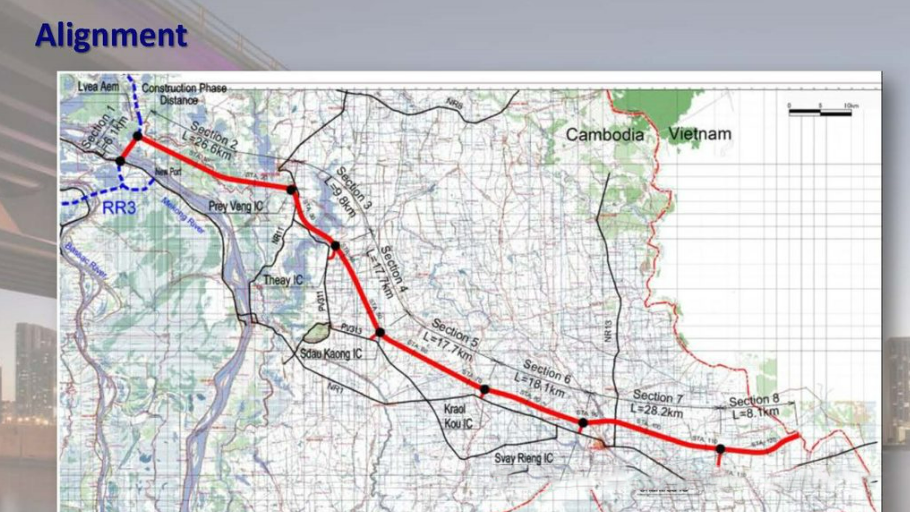
The Phnom Penh to Bayu Expressway in Cambodia will start construction in June 2023, with a total length of about 135 kilometers and a planned total investment of about 1.38 billion US dollars. It will be jointly invested and constructed by China Road and Bridge Corporation, passing through the provinces of Gangra, Prey Veng, and Chai Rieng, and ultimately leading to the Bayu area on the Vietnamese border. On the Vietnamese side, the Ho Chi Minh City to Mukden Expressway is approximately 51 kilometers long and is an important transportation project connecting Ho Chi Minh City and the Mukden Port direction. According to the plan disclosed by the Vietnamese Ministry of Construction in February 2026, the two sides plan to promote the connection in stages, with priority given to using existing wooden signs to connect to the Bayu International Port and related roads in the near future, and studying the construction of new cross-border connection channels in the future. Hong Manai also emphasized that the interconnection of transportation infrastructure is only the first step, and the next stage should promote the integration of manufacturing, industrial parks, and supply chains. Both sides are also pushing to include the Dannan Mianzhi International Port in the cross-border transportation agreement.
Cambodia and Laos discuss multimodal connectivity
According to the Cambodian Ministry of Public Works and Transport, during the 2026 Global Sustainable Transport Forum, Cambodian Minister of Public Works and Transport, Binbonne, and Laotian Minister of Public Works and Transport held bilateral talks to discuss three areas of cooperation: studying the feasibility of connecting Cambodia's National Highway 7 with Laos' National Highway 13, determining the location for the construction of the Tonle Ropou Se Lamphao Bridge and connecting road, and studying the construction of a railway connection between the two countries. Both parties agree to establish a joint working group to accelerate the feasibility study of relevant projects and promote subsequent implementation. In his speech at the forum, Binboni stated that sustainable transportation is an important foundation for enhancing economic resilience and promoting trade integration. Cambodia is promoting infrastructure projects such as highways, expressways, railways, ports, airports, waterways, and logistics centers, and will make reducing logistics costs and improving connectivity an important goal for transportation development. Keywords: Southeast Asian news and information, transportation infrastructure, highways

From road connectivity to industrial synergy
Overall, Cambodia's recent cross-border transportation plan presents two noteworthy directions. The transportation cooperation between Cambodia and Vietnam focuses on connecting important economic centers of the two countries. With the gradual improvement of the corridor from Phnom Penh to Bayu to Mukden to Ho Chi Minh City, the logistics connection between the eastern region of Cambodia and the manufacturing base in southern Vietnam is expected to be improved, providing more convenience for cross-border transportation of raw materials, components, and finished products. The cooperation between Cambodia and Laos focuses on the connection of various transportation modes such as highways, bridges, and railways. If relevant projects are gradually implemented, it will help expand the land transportation links between Cambodia and Laos, providing new support for the development of regional trade and logistics networks. For Chinese investors and enterprises, the construction of cross-border transportation infrastructure not only involves engineering contracting and equipment supply, but also deserves continuous tracking from the perspective of industrial layout. New cooperation opportunities may arise in areas such as industrial parks, warehousing and logistics, cross-border transportation, and supporting services along the route in the future. Cambodia is trying to transform its transportation infrastructure construction into a regional economic and trade cooperation advantage. With the further clarification of cross-border connectivity plans, whether the relevant channels can truly achieve logistics cost reduction, industrial synergy, and investment agglomeration will become an important indicator for observing the effectiveness of Cambodia's regional connectivity.Editor/Gao Xue
Comment





 Praise
 Collect
 Comment

 Share
Share


Write something~