 Search


- Railway safety coordination landing, adding assistance to China's efforts to open up the Indian Ocean sea route
- The safety coordination of the China Myanmar Railway has been launched, laying a solid foundation for the construction of the China Myanmar Economic Corridor
Recently, the Chinese delegation held communication and coordination talks with relevant parties in Myanmar regarding the safety and security of the China Myanmar railway project. This railway is planned to connect Kunming, Yunnan Province, China, and the deep-water port of Kyaukpyu, Rakhine State, Myanmar. It is a key strategic project for China to open the sea passage to the Indian Ocean, and also an important part of the the Belt and Road Initiative and the Western Line of the Trans Asian Railway.
Due to the ongoing conflict in the Kyaukpyu region of Myanmar and the need for railway lines to pass through relevant areas, China is promoting the establishment of specialized dialogue and security coordination mechanisms to ensure the smooth progress of the project. In addition, the Chinese side plans to restart the construction of the Kunming Kyaukpyu railway in May 2026, and the relevant engineering machinery and equipment have already arrived in Myanmar. However, the safety environment along the route remains complex, bringing certain variables to the implementation of the project.
The China Myanmar Railway will be implemented in two phases within Myanmar: the first phase will build the Muse Mandalay section, with a total length of 431 kilometers; The second phase of construction includes the Mandalay to Kyaukpyu Port section, with a total length of 494 kilometers. The estimated investment for the Mujie Mandalay section is about 8.9 billion US dollars, and the project includes 124 bridges, 60 tunnels, and 11 power stations. In November 2025, Myanmar announced the establishment of the Muse Mandalay Railway Project Steering Committee to provide institutional support for the project's progress. Keywords: China Myanmar Railway, Economic Corridor, Interconnection
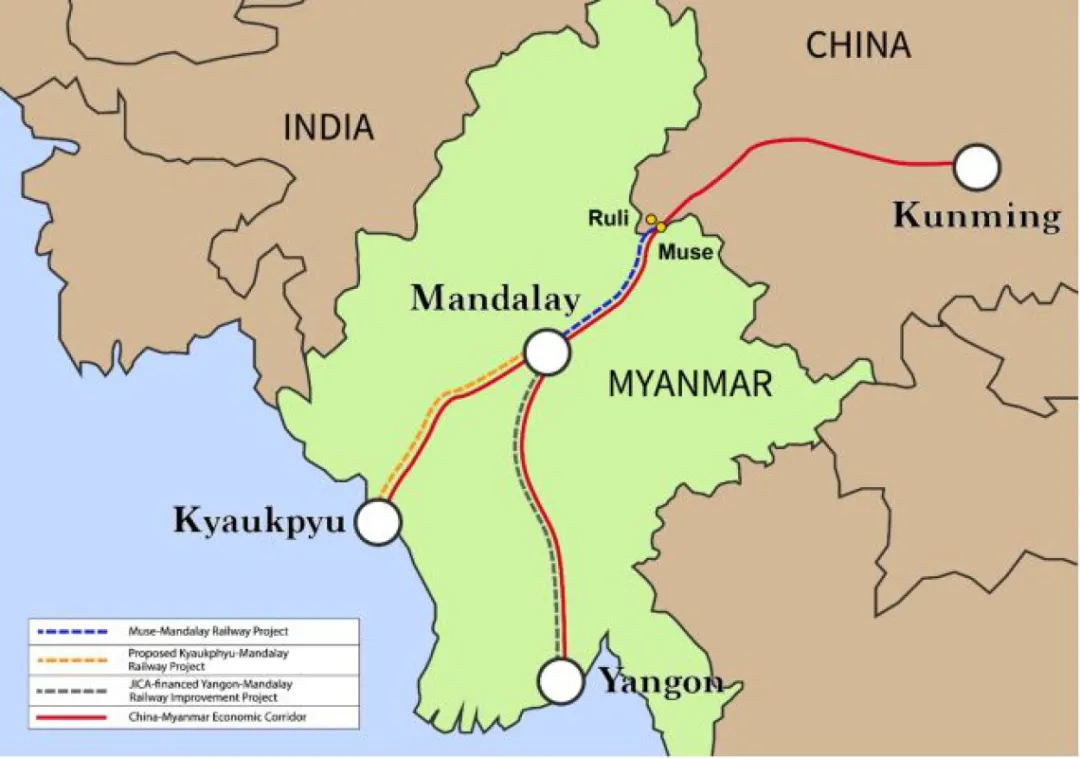
The China Myanmar Railway will work together with projects such as the Jiaoyu Deep Water Port and the China Myanmar Oil and Gas Pipeline to become an important pillar of the China Myanmar Economic Corridor. Myanmar has repeatedly stated that it will prioritize the implementation of the above-mentioned key infrastructure projects, in order to enhance regional connectivity and drive practical cooperation in the fields of energy, logistics, and industry.Editor/Gong Ziwei
Comment

 Praise
 Collect
 Comment

 Share
Share


Write something~