 Search


- Cross Caspian Sea fiber optic cable opens up a shortcut for Central Asian data to travel westward
- Transforming geographical crossroads into digital hubs, providing new opportunities for regional connectivity and joint investment
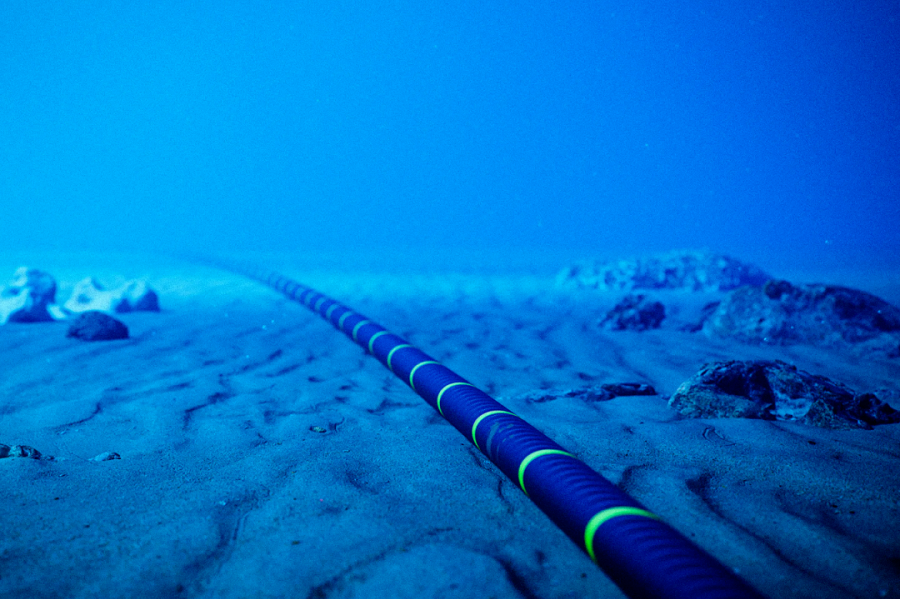
Late at night, a design drawing sent from Almaty to Europe used to have to detour north and pass through a fiber optic node in a neighboring country. After several transfers, it finally landed on the customer's screen. Today, it can enter the sea in Aktau, turn into a beam of light, stick to the bottom of the Caspian Sea all the way west, land in Sumgait, Azerbaijan, and then access the European backbone network through the South Caucasus and Türkiye. By taking a shorter detour, there will be an additional digital shortcut between Central Asia and Europe that does not depend on the appearance of other nodes.
A beam of light crosses the Caspian Sea
The recently opened Aktau Sumgate trans Caspian fiber optic communication line has a total length of about 380 kilometers and is laid on the seabed of the Caspian Sea, with a designed transmission capacity of over 400 terabits per second. On October 15th, the heads of state of Kazakhstan and Azerbaijan jointly witnessed the launch online in Baku; Under the framework of the Digital Silk Road Initiative launched by Azerbaijan, the project is implemented by a joint venture between telecommunications companies from both countries.
At the ministerial group meeting of the first high-level digital connectivity platform conference, the Deputy Foreign Minister of the Republic of Kazakhstan, Arman Ishetov, brought the topic to this new line. He said that the opening of the line has opened up new opportunities for building a unified digital corridor between Central Asia and Europe.

Public information shows that about 95% of Kazakhstan's outbound traffic previously had to go through cross-border fiber optic links to Russia, and a single node failure or policy change could potentially affect the network of the entire region; This westward high-capacity exit fills in the lesson of routing diversity.
From the channel to the hub
Ishetov emphasized in his speech that Kazakhstan plays a strategic role in strengthening transportation and digital connectivity in the Eurasian region.
This sentence is not just diplomatic rhetoric. The Trans Caspian International Transport Corridor has long transported goods from China to the South Caucasus and Europe via Central Asia and the Caspian Sea. Now, the same axis has added another layer of numerical meaning: the middle corridor not only runs containers, but also begins to run data.
After the hardware is in place, what Hafang wants to catch is a larger industry. The data center valley under construction by Ekibastuz aims to be an international cluster covering data centers, cloud services, and artificial intelligence infrastructure; The westward fiber optic cable has created conditions to attract global technology companies and directly connect local computing power with the European market.
From passive end users to intermediate nodes capable of providing transit and computing services, the role change has just begun. It should also be noted that fiber optic cables are only physical channels, and the designed capacity does not equal the actual traffic. Differences in prices, service quality, telecommunications regulations, and data governance rules along the route may still become the threshold for whether data is willing to take this path or not.

Put cooperation into the project
That's why the focus on the conference table has shifted from the circuit itself to how to use it together. All parties emphasized the importance of expanding the potential for cooperation in the development of digital infrastructure and the implementation of joint investment projects under the framework of the EU Global Gateway Initiative and Interconnection Platform. This is in line with the pace of the past two years: the first Central Asia EU Summit in 2025 will launch a global gateway investment plan with a total amount of 12 billion euros, and digital connectivity will be listed as a key area;
In October of the same year, the EU convened representatives of member countries, Armenia, Azerbaijan, Moldova, Türkiye, Ukraine and five Central Asian countries to discuss cross regional connectivity initiatives. The core is transportation, energy and digital connectivity; At the end of the year, the joint statement between Kazakhstan and Europe confirmed the joint promotion of the Trans Caspian International Transport Corridor.
The technology partnership has thus gained specific leverage. The Deputy Foreign Minister confirmed that the Republic of Kazakhstan is ready to further strengthen its technological partnership with the European Union and develop regional digital connectivity.
The light has already passed, and the next step is to see if joint investment, operational collaboration, and rule docking can keep up; The real test is still ahead, from a submarine cable to a sustainable digital corridor.Editor/Yang Meiling
Comment







 Praise
 Collect
 Comment

 Share


Write something~