 Search



- In 2025, Chinese enterprises will enter a new stage of going global, from "going out" to "going in"
Data shows that China's goods trade exports reached 24.46 trillion yuan in the first 11 months of 2025, a year-on-year increase of 6.2%. Chinese enterprises going global have shifted from passive safe havens to active globalization, but still face severe challenges in cross-cultural communication, localized operations, and other aspects. How to resolve cultural conflicts and achieve deep integration has become the core issue for high-quality development of Chinese enterprises going global.
The collision of values from workaholism to life balance
Under the wave of globalization, the road for Chinese enterprises to go global is not smooth sailing. Some well-known Chinese enterprises have achieved certain results after launching overseas strategies, but still face many confusions. Sending workaholic Chinese backbone to manage overseas teams, attempting to impose a high-intensity work culture on local teams, while local employees appear cooperative but absent-minded. And these managers may also aspire to the other person's work life balance in their own hearts, and this long-term psychological disconnect may ultimately lead to managers on the brink of depression.

This reflects a typical challenge faced by Chinese enterprises in organizing and managing their overseas operations: the value dilemma of the "transformers" themselves in cross-cultural management. When managers attempt to export a culture that is precisely the lifestyle they subconsciously desire but cannot obtain, it can lead to destructive cognitive dissonance. In cross-border team management, formal compromise cannot solve the fundamental cultural conflicts, and localization requires more flexible strategies.
The practice of Northern Mining in the Democratic Republic of Congo provides a successful case. 70% of the local employees in the overseas project company of the company believe in Christianity. Every year before Christmas, the project company will distribute Christmas allowances to the employees and their families in Congo, and invite representatives of the employees and their families to the company for a meal to celebrate the holiday together. This practice of respecting local cultural customs effectively enhances employee satisfaction and sense of belonging.
Deep estrangement beneath surface consensus
There are natural barriers between different cultural groups in Southeast Asian multicultural teams, and superficial consensus alone cannot solve deep collaboration barriers. Cultural differences stem from self-centered judgments, but they cannot be solely attributed and need to be analyzed from multiple dimensions such as personal communication styles. The "natural" thinking in cross-cultural understanding is dangerous, just like the metaphor of "fish don't know water", culture is intangible but ubiquitous.
Even after learning tools such as MBTI and emotional intelligence, it is still difficult to solve problems in practice. Cultural differences at the level of values are more difficult to detect than at the level of behavior. Emotions also play a crucial role in cross-cultural team collaboration, as they silently transmit and trigger opposition, leading to difficulties in collaboration. Hofstede's six dimensional cultural theory is the culmination of 40 years of cross-border research, with each dimension being independent and unrelated.The art of balancing localization and globalization
The successful cases of Chinese enterprises going global prove that cultural integration is the key to breaking through the impasse. Shang Xiangmin, co-founder of Bawang Tea Ji, shared that currently it has over 7000 global stores and nearly 300 overseas stores, covering Southeast Asia and North America markets. The "deep localization+cultural integration" strategy has achieved significant results. Enterprises need to do a good job in cultural integration, compliant operation, story dissemination, supply chain guarantee, and local talent utilization when going global, in order to achieve the dual internationalization of Chinese culture and products.
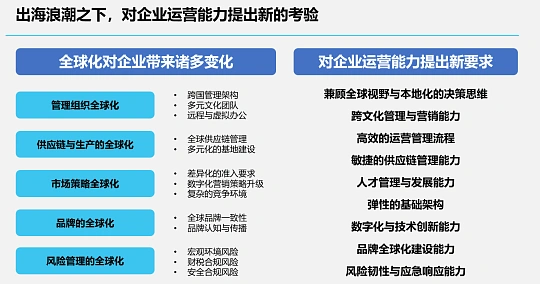
Roland Berger Strategy Consultants' global partner Ji Gang proposed a "four stage theory" for Chinese companies to go global: from foreign exchange exploration, exploratory going global to diversified going global, it has now entered the "deep going global" stage. Going global is a strategic choice for enterprises, which requires shifting from scale expansion to local operations, upgrading from product output to global resource integration. The key to success lies in deep cultivation and compliance building.
In the Saudi market, Hikvision's successful experience is worth learning from. In 2010, it entered the Saudi market and initially sold products to local agents through trade. In 2015, it established an office in Saudi Arabia and grew from an annual sales volume of 20 million US dollars to nearly 1 billion RMB in shipments by 2024, accounting for 60% of the local market share. Hikvision's Saudi team consists of about 100 people, with half of them being Chinese and half being foreign local employees. The business is conducted through four national agents, forming a complete sales network.
The leap from 'Made in China' to 'Chinese Brand'
Currently, Chinese enterprises have shifted from passive safe havens to active globalization when going global. In the first 11 months of 2025, China's goods trade exports reached 24.46 trillion yuan, a year-on-year increase of 6.2%. Chinese enterprises going global have shifted from "going out" to "going in", and cultural integration has become the key. However, Chinese enterprises still face the reality of insufficient brand awareness and the need to improve localization in overseas markets.

In the future, Chinese enterprises going global need to pay more attention to brand building, cultural expression, and digital capabilities. Wang Xin, Vice President of the National Advertising Research Institute, pointed out that by 2025, Chinese brands going global can be summarized as a "new stage of high-quality going global". Enterprises have many highlights in product, manufacturing, mergers and acquisitions, ecological construction, and cultural leadership. Enterprises need to upgrade from "selling products" to "building systems" and "shaping brands", achieving a leap from "Made in China" to "Chinese brand". Keywords: Social Review News
In today's increasingly complex globalization, if Chinese companies want to achieve sustainable development overseas, they must constantly break away from traditional thinking and recognize that capital, technology, and products are only necessary conditions for influence, not sufficient conditions. Only in the process of localization practice, cultural understanding, and value co construction can we truly achieve the transformation from "going out" to "rooting in", and from "survival" to "influence".Editor/Yang Meiling
Comment






 Praise
 Collect
 Comment

 Share
Share


Write something~