 Search


- The world's first to achieve autonomous operation of AI throughout the entire process, ranking at the international leading level
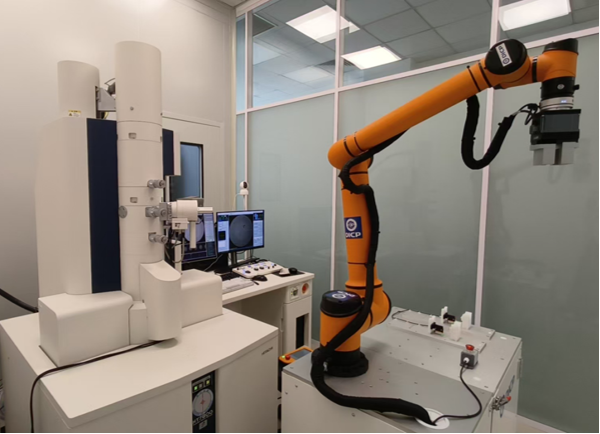
On May 24, 2026, the intelligent transmission electron microscope system "Yuanyan No.1" developed by Deng Dehui and Liu Wei of the Chinese Academy of Sciences Dalian Institute of Chemical Physics passed the scientific and technological achievements appraisal of the China Petroleum and Chemical Industry Federation in Beijing, and was recognized as the world's first and international leader. According to data released by the Ministry of Science and Technology in early 2026, China's localization rate in the field of scientific instruments has increased from less than 10% five years ago to about 25%. The long-term dependence on imported high-end electron microscopes is being broken, and the birth of the "Yuan Yan 1" is a key node in this trend.
Five key technologies to conquer unmanned areas
The system has achieved unmanned and intelligent operation of the entire process of sample transmission, imaging, and analysis. The team, in collaboration with Researcher Han Zhi from the Shenyang Institute of Automation, Chinese Academy of Sciences, has developed the "Fully Autonomous Perception Analysis Control Universal Intelligent Transmission Electron Microscope System" algorithm, which has overcome five key technologies: embodied intelligent high vacuum sample transfer, electron optical imaging autonomous adjustment, nanoscale sample intelligent positioning, image autonomous acquisition and real-time analysis, and full system state perception and scheduling collaboration. This is the first leap of transmission electron microscopy from manual operation to AI full process autonomous operation.
From Seeing Atoms to Understanding Atoms
The "Original Eye One" is like an intelligent eye that understands the atomic world, not only able to see, but also capable of independent thinking. Traditional transmission electron microscopy single experiments require operators to be on duty for several hours, while this system can independently complete the entire process from sample loading to data analysis, increasing efficiency by several times and significantly improving data consistency.
Currently, the global trend of AI for Science is accelerating, and according to Nature's statistics at the beginning of 2026, over 40% of top journal papers have used AI assisted analysis. The intelligentization of high-end scientific research instruments has become an inevitable direction. Yuanyan No.1 provides large-scale, high-quality structural data for fields such as energy and chemical engineering, materials genomics, and life sciences, which will strongly support the AI driven paradigm shift in scientific research and set a benchmark for the intelligent application of domestic high-end instruments.Editor/Cheng Liting
Comment







 Praise
 Collect
 Comment

 Share
Share


Write something~