 Search


- Planned to be put into operation in 2028, it will only take 2 hours and 15 minutes from Moscow to St. Petersburg
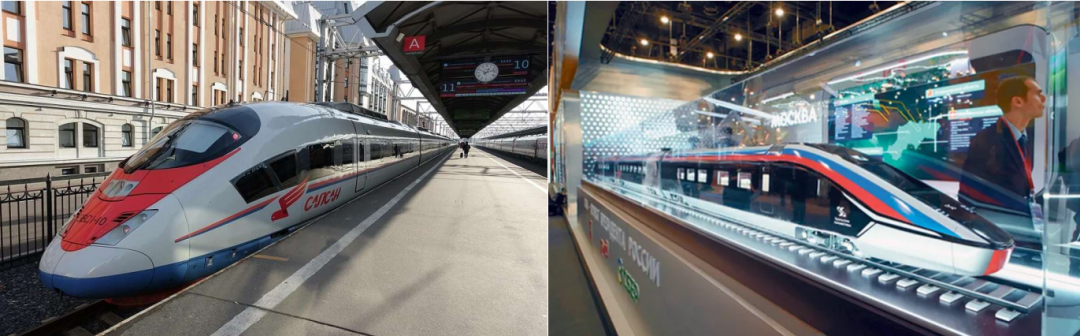
In the workshop of Ural Locomotive Works, a huge metal frame is slowly being closed. With the precise embedding of the first high-strength fiberglass composite material front cover, the outline of the driver's cab of Russia's first domestically produced high-speed train is gradually becoming clearer. This is not just an ordinary assembly, but also a crucial battle for Russia to break free from external technological dependence and reshape the railway system. Previously, the main transportation artery connecting Moscow and St. Petersburg was long dominated by Siemens' Sapsan train. Now, the rise of local power is about to rewrite this pattern.
Head module completed assembly
The focus of this assembly is on the "brain" and "face" of the train. Engineers conducted the first trial installation of the driver's cab and head module, aiming to rigorously inspect the geometric matching and structural connection accuracy between components. The front cover of the train adopts a special composite material and metal embedded structure, which is not only to improve the airtightness of the cockpit, but also to effectively resist severe pressure changes when the train is running at hundreds of kilometers per hour. At the same time, the front module made of polymer and metal, like a sturdy armor, is equipped with a dedicated drive device that will be responsible for protecting the internal precision equipment from flying snow, ice, and dust in extremely cold weather.
Breakthrough at a speed of 400 kilometers per hour
Compared to the current Siemens trains with a running speed of 200 kilometers per hour, the ambition for domestically produced new cars in Russia is much greater. Design data shows that the new car can reach a maximum design speed of 400 kilometers per hour, and the operating speed will also be locked at 360 kilometers per hour. This performance leap means that Russia's rail transit equipment research and development capabilities are attempting to enter the world's top tier. With the construction of the first high-speed railway line, these steel behemoths will no longer be mere concepts on blueprints, but will soon be tested for their quality in actual combat. In order to match the high-speed performance of the new car, the upgrading of the supporting line infrastructure is also being promoted synchronously.
Naming Game and National Image
In addition to hard core technological breakthroughs, the name of this train has also become a subject of study. At first, the Russian side planned to name it "White Falcon", symbolizing precision and strength. However, zoologists pointed out that the flying speed of the white falcon is actually much slower than that of the peregrine falcon known for its high speed, which immediately sparked controversy and was shelved. At present, the marketing expert team is intensively evaluating alternative solutions, including "Sapsan-2", "Sapsan-400", and the "Luch" meaning beam of light. The Russian Deputy Prime Minister emphasized that the final name must be closely linked to the grand image of the country, not only running fast, but also having a loud name.keywords:Infrastructure News
All these efforts are for the year 2028. At that time, the first high-speed railway with a total length of about 679 kilometers will traverse the hinterland of the European part of Russia, compressing the time and space distance between the two super cities of Moscow and St. Petersburg to 2 hours and 15 minutes. This is not only the opening of a railway, but also an important milestone in the process of Russia's industrial autonomy.Editor/Yang Meiling
Comment

 Praise
 Collect
 Comment

 Share
Share


Write something~