 Search


- Wholly acquire adapter companies, Zhipu breaks down barriers to the operation of multiple domestic chip models
- ByteDance and Zhipu are simultaneously deploying 1GW of domestically produced computing power in China, with different development paths
China's AI computing power autonomy is transitioning from building hardware to building systems. When the local Internet giants and model companies respectively hit the 1GW level domestic intelligent computing cluster, a bifurcation between the ownership of computing power and the ecological discourse has emerged: on one hand, it is a closed private cloud logic, and on the other hand, it is a cross chip common public infrastructure logic.
ByteDance builds its own dedicated computing power cluster
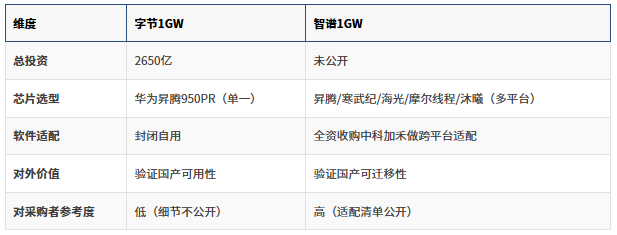
ByteDance plans to invest 265 billion yuan to build a 1GW intelligent computing center, fully equipped with Huawei Shengteng 950PR chips, and will add 400 to 500 MW of computing power in two batches later, serving its own AI business in China as a whole. This system is essentially a huge private cloud - it proves that domestic chips can run and be used in the large-scale scene of the head Internet enterprises, but the experience is closed inside, and the adaptation results are not shared.

Zhipu is taking a different path. The country's model enterprise has established a 1GW national computing power center and fully acquired Zhongke Jiahe from the Institute of Computing Technology of the Chinese Academy of Sciences. The latter focuses on heterogeneous computing power adaptation, allowing the same GLM model to run across multiple domestic chips such as Ascend, Haiguang, Cambrian, etc. Zhipu's own business has already localized 70% of its computing power, and acquiring an adaptation team means taking back the initiative in how to use computing power.

For the same 1GW, Byte answered whether domestic chips can support the business of a domestic giant, while Zhipu answered whether domestic chips can be used universally by different models and customers. The former verifies usability, while the latter verifies transferability.
The bottleneck is not in the transistor, but in the compiler
Domestic computing power is often misunderstood as hardware failure. The fact is that the nominal computing power parameters of Ascend, Cambrian, and Haiguang have already caught up with the first tier, and the real weakness lies in the software stack: models, operators, and frameworks written in the CUDA era often have reduced inference efficiency, lack of compatible operators, and migration cycles calculated on a monthly basis when switched to domestic chips. The value of Zhongke Jiahe lies in this - using a unified compiler and virtual instruction set to translate ecological chimneys such as Ascend, Cambrian, and Haiguang into the same set of interfaces. Zhipu chose to fully acquire this team from the Chinese Academy of Sciences instead of outsourcing adaptation, indicating that in the country's model industry, heterogeneous compilation capability has been regarded as a strategic asset equally important as computing power. When hardware parameters converge, adaptation breadth and inference cost become new dimensions of competition. Whoever can convert the theoretical computing power of domestic chips into effective tokens holds the bargaining power for the next stage of AI infrastructure.
Model core verification becomes a new ruler
A previously overlooked trend is that in the Chinese market, large model enterprises have essentially taken on the role of verifying domestic chips. On the day of the release of DeepSeeker V4, eight domestic chip manufacturers collectively announced the Day 0 adaptation; Zhipu GLM-5.2 synchronously covers platforms such as Ascend, Cambrian, Haiguang, Mole Thread, and Muxi; Meituan LongCat-2.0 uses over 50000 domestic cards to run through trillion parameter pre training. This means that the logic of purchasing computing power has changed. In the past, we looked at chip specifications, but now we have to see whose models have been widely tested on them. At least three questions should be asked when evaluating domestic computing power: whether there are leading model companies publicly adapting, whether the adaptation has entered the production level, and whether the coverage of domestic chip categories is wide enough. The wider the coverage, the less likely the selection is to be bound to a single chip. Keywords: China Computing Power, Intelligent Computing Center
ByteDance used 265 billion yuan to promote domestic chips to the core of its head business, while Zhipu used 1GW and a compiler team to pull domestic chips into the general software layer. In the context of the decoupling of computing power between the two countries, the autonomy of China's AI infrastructure is no longer about whether there are domestically produced chips, but whether models, compilers, and chips can evolve together. Taking this step forward, 1GW is not just a stack of electricity and servers, but the true underlying support for China's intelligent economy.Editor/Gong Ziwei
Comment

 Praise
 Collect
 Comment

 Share
Share


Write something~