 Search


- China's first 2-ton load-bearing tethered balloon completes trial operation in southeastern Tibet
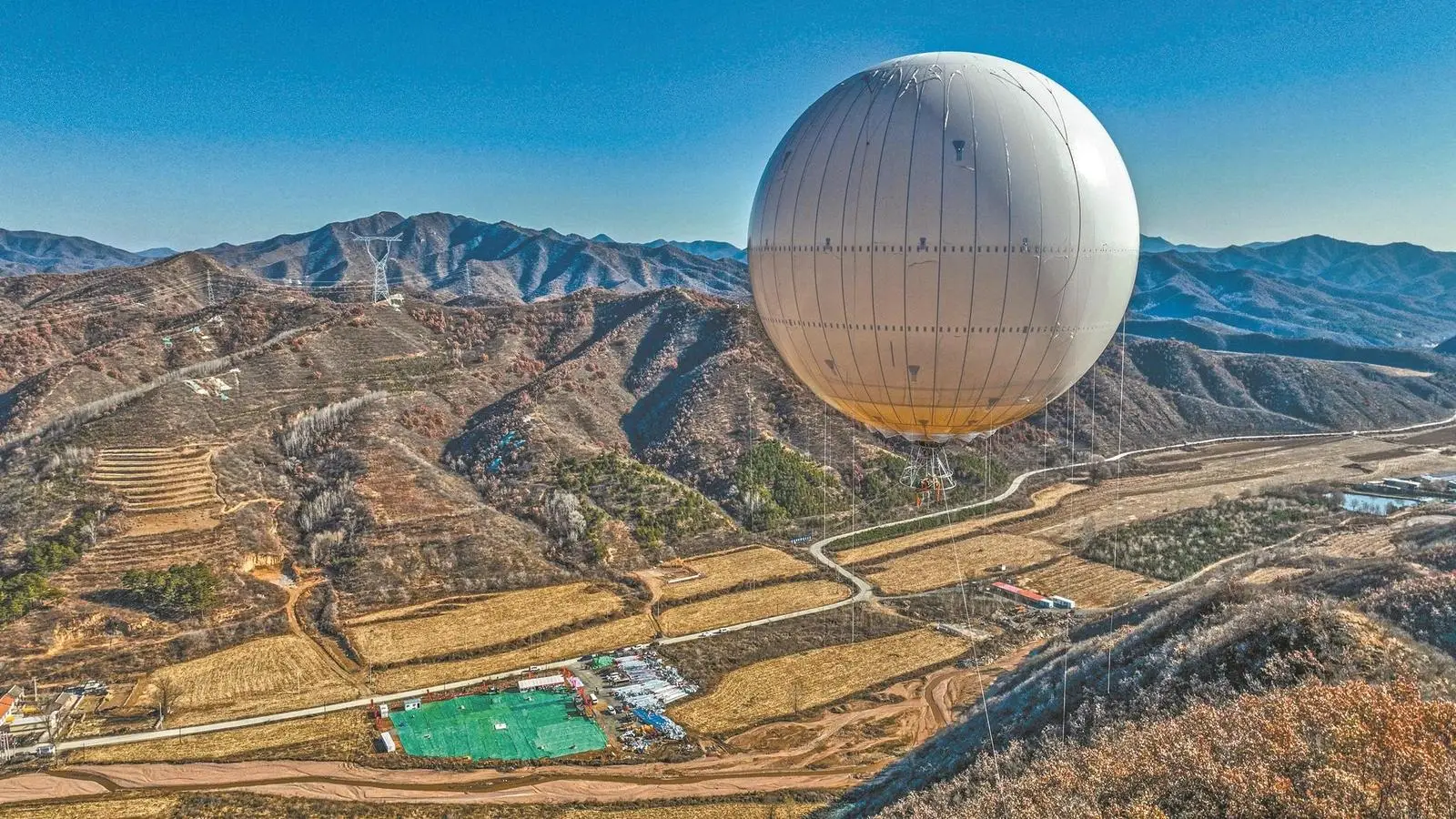
On the ridge at an altitude of 4000 meters in southeastern Tibet, the mountain wind carries broken snow all year round and brushes over steep slopes. On September 21, 2026, the first 2-ton load-bearing tethered balloon in China completed its trial operation here, finally finding a new green solution to the most difficult material transportation problem of the Tibet Guangdong ultra-high voltage project.
An 8-story aerial transportation platform
A tethered balloon with a diameter of 25 meters and a volume of 8000 cubic meters slowly ascended from the construction site, equivalent to an 8-story floating platform steadily floating in the mountain wind. Multiple cables were synchronously pulled and retracted, and the transmission tower material weighing 2 tons was steadily lifted and moved along the predetermined route towards the ridge operation point.
This equipment is connected to the balloon and ground control device through cables, relying on helium buoyancy to bear the main load, breaking through the problem of imbalanced posture trajectory deviation in strong wind environments, and automatically completing tower material grasping and release without the need for manual high-altitude assistance throughout the process. The latest test data from State Grid in 2026 shows that the horizontal movement accuracy of the equipment can be controlled within 0.2 meters, and the vertical lifting error does not exceed 0.1 meters, fully meeting the requirements of precise lifting in high-altitude mountainous areas.
New construction path in complex mountainous areas
Nearly 90% of the Tibet Guangdong UHP Xizang section is mountainous, and 30% is high mountains. Most tower sites are located on steep ridges with no roads. Traditional road construction has a long transportation cycle and causes significant ecological disturbance. Cableway installation is severely limited by terrain, and ordinary drones are difficult to carry continuous transportation of large tower materials.
The deployment of tethered balloons is flexible and rapid, greatly reducing their dependence on terrain. Compared to traditional transportation methods, it can reduce the investment in temporary facilities by more than 70%, greatly reducing the disturbance to high-altitude fragile ecosystems. At present, the domestic low altitude power transportation system has formed a coordinated layout of heavy load unmanned aerial vehicles, airships, tethered balloons, and multiple equipment, promoting the continuous upgrading of power grid construction towards mechanization, intelligence, and unmanned direction.
The mountain wind brushes over the skin of the floating platform, and this giant balloon hidden in the valleys of the plateau is opening up a new green air channel for the construction of high-altitude ultra-high pressure.Editor/Cheng Liting
Comment

 Praise
 Collect
 Comment

 Share
Share


Write something~