 Search


- The weight of this memorandum lies in Iraq's ability to hold data sovereignty in its own hands
- Transitioning from purchasing equipment to building capabilities, laying the foundation for digitalization in oil and gas, transportation, and healthcare
More than twenty years ago on a snowy day, two Chinese engineers were invited by soldiers to a several square meter outpost on the Iraqi border. They drank a cup of hot red tea with sugar on it, but their passports didn't even have a stamp, so they walked into this country. At that time, Huawei's representative office in Iraq had less than ten people, and the office and accommodation were squeezed into two small buildings. The internet speed was so slow that one had to climb upstairs to adjust the satellite antenna.
Twenty three years later, the descendants of these pioneers stood on the signing platform in Baghdad.
Baghdad signs new agreement
Recently, the 5th Iraq International Information and Communication Technology Exhibition and Conference (ITEX 2026) was held in Baghdad. The Iraqi Ministry of Communications signed a memorandum of understanding with Huawei to plan the construction of modern enterprise data centers nationwide. The agreement was signed by the state-owned Communications and Information Corporation and the senior management of Huawei, presided over and witnessed by the Minister of Communications, Mustafa Sanad.
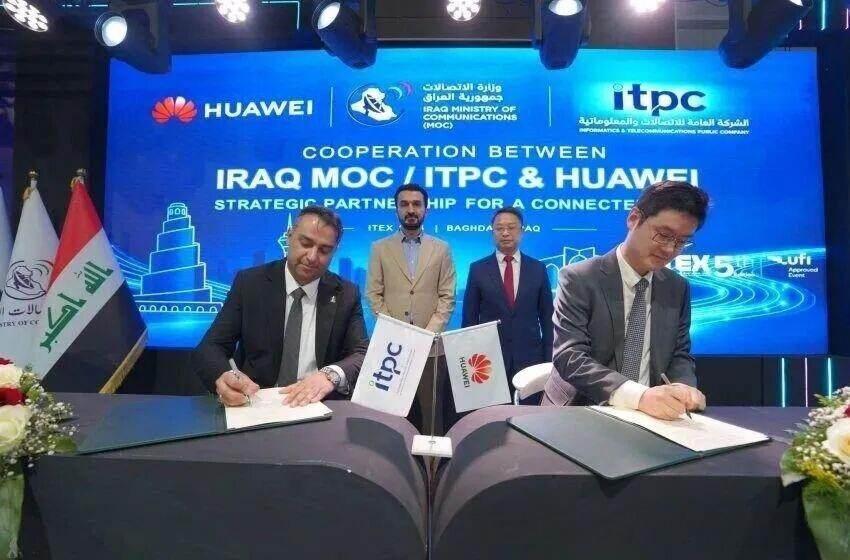
The cooperation focuses on three things: the construction of sovereign cloud hosting capabilities, the improvement of service quality, and the expansion of international technology cooperation scope. Huawei Iraq Vice President and Board Member Rafid Abbas Hafaj said that this is Huawei's first time participating in ITEX as an exhibitor.
Rooted in 23 years
Huawei has been conducting commercial operations in Iraq since 2003 and currently has four main regional branches in Baghdad, Basra, Erbil, and Sulaymaniyah, supporting a broader ecosystem of over 10000 people. The company has collaborated with more than 240 local enterprises in various industries.
Halfaji stressed that Huawei has maintained full operation during all previous security and economic challenges in Iraq, including the continuous on-site work of the Chinese engineering team during the COVID-19. The enterprise business and operator business constitute the main body of its business in Iran, serving major mobile network operators, as well as sovereign institutions such as the Ministry of Petroleum, Ministry of Transport, Ministry of Interior, Ministry of National Defense, and the General Secretariat of the Council of Ministers.

At the exhibition, Huawei showcased end-to-end solutions covering digitalization of oil and gas, telecommunications, intelligent transportation, medical systems, artificial intelligence, and modular data center architecture. In addition to the central government network, the business also extends to provincial intelligent security, such as the comprehensive municipal monitoring network in Babylon Province, and promotes intelligent electric vehicle systems and cloud infrastructure.
Hafaji also clarified that although Huawei is well-known among consumers for its smartphones, mobile phone sales are the smallest part of its business portfolio in terms of business volume.
Computing power is redefining the Middle East
Looking at it in a larger context, this signing is on two trend lines. Firstly, artificial intelligence workloads are driving the most profound architectural restructuring of data centers in decades, requiring redesign of everything from power supply and cooling to networks and storage. The high temperature climate in the Middle East has made cooling challenges even more prominent, making modular and energy-efficient solutions a necessity. Secondly, Iraq is being repositioned by regional interconnectivity - cross-border land fiber optic cables, submarine fiber optic cables, and data corridor projects are all attempting to transform the country from an oil and gas corridor into a data node connecting the Gulf and Europe; Under the framework of the Digital Silk Road, investments in cloud computing, smart cities, and 5G are also continuously tilting towards the Middle East.

In this pattern, sovereign cloud hosting is not just about building a few data centers, but about keeping computing power, data, and governance rules within the borders of the country. For Iraq, this is writing the second growth curve beyond oil into infrastructure; For Huawei, it means exchanging 23 years of local experience for the next phase of long-term contracts. Where data stays, future industry opportunities will grow.Editor/Yang Meiling
Comment



 Praise
 Collect
 Comment

 Share
Share


Write something~