 Search


- China's AI open-source and low-priced model wins recognition in the global southern market

On August 5, 2026, The New York Times published an article stating that in African technology centers, developers are more inclined to choose Chinese artificial intelligence models. The article points out that the current AI industry in China is flourishing, especially in developing countries where the landing momentum is more prominent. The core demand of these markets is very clear: to find practical technology solutions with controllable costs and stable experiences.

Open source low-cost model attracts African developers
In sharp contrast to the closed source payment models launched by American AI companies such as OpenAI and Anthropic, mainstream AI models in China generally adopt a fully open source model, where users do not need to pay fees or apply for authorization in advance, and can directly download and make secondary modifications according to their own needs. In interviews conducted in Kenya, Uganda, and other African countries, reporters found that local developers, policy makers, and corporate executives jointly outlined a rapidly iterating AI market landscape: the cost of use, threshold for computing power resources, data autonomy and controllability, and localized customization and adaptation capabilities are far more valued than the research and development origin of an AI model. The vast majority of practitioners only need a practical product that can run stably and smoothly under limited hardware resources.
Self deployment reduces long-term costs
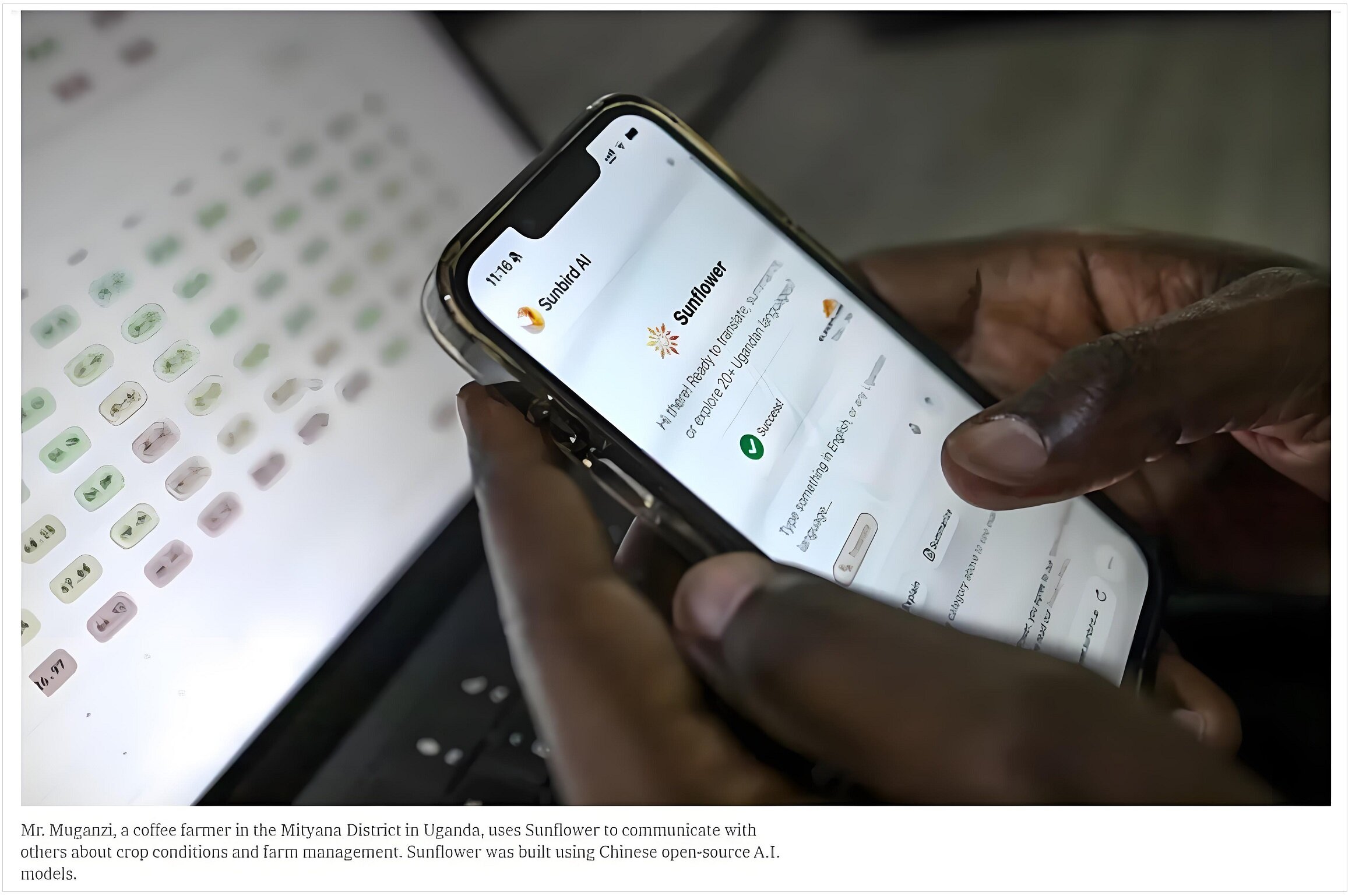
Many respondents likened using Chinese AI models to owning a completely their own house. Developers do not need to invest millions of dollars in training basic models from scratch, but only need to download a mature Chinese open-source AI system to build completely independent new products on this basis. The subsequent costs are almost solely from server hardware expenditures. However, using the closed source model in the United States is more like long-term rental housing, as these models are mostly standardized and universal technologies, and users need to continuously pay subscription fees and various additional service fees according to different usage scenarios, resulting in high long-term usage costs. The Sunflower language model in Uganda is one of the cases built based on the Chinese open-source model Qwen3. Keywords: social commentary, news and information AI
Twenty years of cooperation to solidify the foundation of trust
In the process of implementation and promotion, Chinese companies continue to strengthen their support for localization: providing free computing power quotas for African AI developers, providing hands-on engineering and technical guidance, and helping local teams quickly get started with AI development. This market recognition does not come out of thin air, but is rooted in the deep technical cooperation foundation accumulated by both parties over the past twenty years. As early as before, Chinese companies had helped many African countries build extensive communication networks and participated in the construction of a large number of transportation infrastructure. Deep technological cooperation has laid a solid user base and market trust for China in Africa, which has now become a natural basis for the landing and promotion of AI technology in China. Many African AI developers have stated that Chinese companies truly consider African teams as their core service targets, while American AI manufacturers have hardly laid out any landing services in the African market.Editor/Gao Xue
Comment





 Praise
 Collect
 Comment

 Share
Share


Write something~