 Search


- Energy security replaces emissions reduction as the main driving force
- Photovoltaics are bringing cheap green electricity to the world
- And the power grid and energy storage will determine whether this expansion can truly be realized
In the afternoon, photovoltaics push electricity prices below zero, and after sunset, they bid for each kilowatt hour of electricity. This is a footnote from the International Energy Agency's "2026 Renewable Energy Report" last week: it's not just about affordability, but also about timing for power transmission. The report predicts that from 2026 to 2031, there will be an additional 3.6TW of photovoltaic installed capacity worldwide.
Photovoltaic beam
Photovoltaics account for three-quarters of the global renewable energy expansion by 2031: more than half of the 3.6TW, or 2TW, will be large-scale ground photovoltaics, while distributed photovoltaics such as household, commercial, and off grid will add 1.5TW by 2031, with outstanding cost-effectiveness.
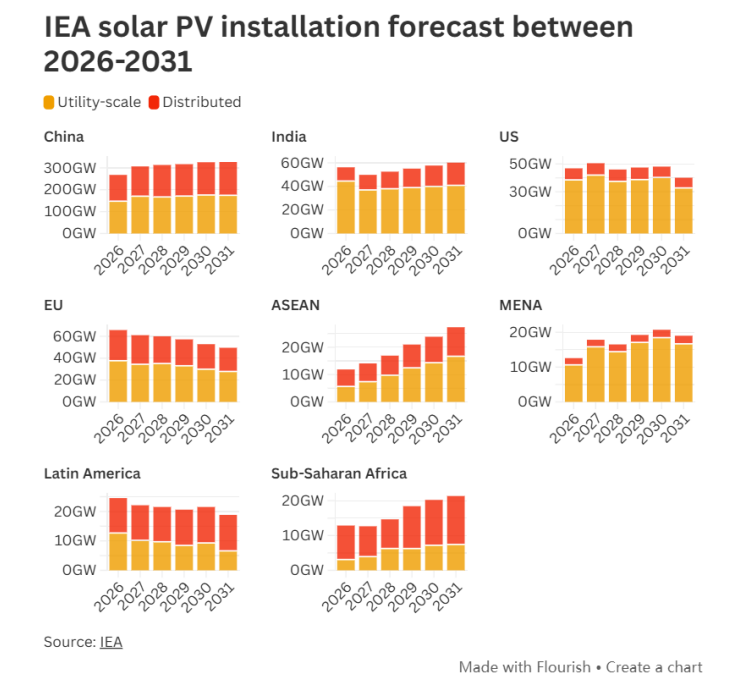
China remains the core but its growth rate is slowing down, with the global proportion of new additions dropping from 60% in 2025 to 53%; India's growth rate from 2026 to 2031 will increase by 1.6 times compared to the previous six-year cycle, contributing nearly 8.5% by 2031, making it the second largest contributor and the only country outside China capable of producing all core components of the photovoltaic supply chain on a large scale. The overall growth rate of ASEAN, Middle East and North Africa (MENA), and sub Saharan Africa has doubled, with photovoltaics being the main focus. ASEAN will have the highest annual growth rate by 2031; Latin America has fallen from its peak in 2026, but Mexico, Chile, and Colombia have remained relatively stable due to the slowdown in Brazil. Most regions rely on ground power stations, while Latin America and sub Saharan Africa are mainly distributed. South Africa and Nigeria together contribute nearly half of the newly installed capacity in the region. Except for Latin America, the European Union is the only region experiencing a decline; The United States will reach a peak of 50GW in 2027 and fall back to 40GW in 2031.
Safety becomes a driving force
The driving force has also been changed. The ongoing conflict in the Middle East initiated by the United States and Israel against Iran, coupled with the current energy crisis, has pushed renewable energy to the core of multi country policies: domestic scenery is not restricted by the strait, directly reducing dependence on imported fuel. Birol said that environmental concerns used to be a priority, cost reduction has made photovoltaics competitive, and energy security has become the core driving force; Renewable energy currently accounts for one-third of global electricity generation and is expected to approach 50% in the next five years. In 2031, its power generation proportion will increase from 33% in 2025 to nearly 45%. From 2026 to 2031, the total wind and solar power generation will more than double, accounting for over 28% of the global total power generation. In 2029, photovoltaic super hydropower will become the largest renewable power source. Accelerating the reform of bidding, power grid, energy storage and approval, it is expected to achieve the COP28 triple installation target by 2031, with a slightly lower baseline scenario and a 20% higher acceleration scenario.keywords:New energy information network
The system needs to make up for the missed classes
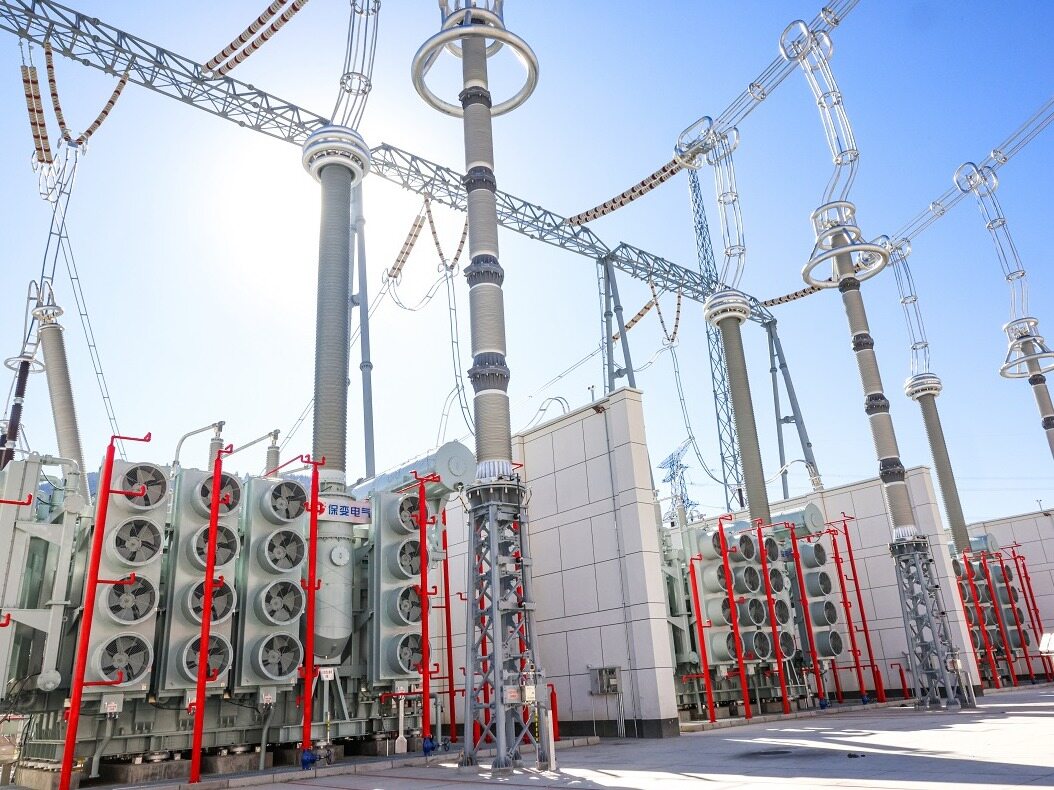
By 2031, the proportion of volatile renewable energy in 17 countries will exceed 50%, and the power grid, energy storage, peak shaving power sources, and demand side flexibility must all keep up. The abandonment rate of wind and solar technology in the core market will almost double in 2024 and 2025, with nearly 200 TWh of abandoned electricity in 2025 and over 800 TWh in 2031, equivalent to nearly 8% of the total volatile renewable energy generation; The frequency of negative electricity prices in Europe has increased, driving down the profits of market-oriented projects and corporate power purchase agreements, reminding electricity to be delivered at the right time. The IEA stated that battery energy storage systems (BESS) have alleviated some challenges but not as expected; Wind and solar power distribution and storage are preferred, and the cost of hybrid power generation in most regions around the world is already below $75 per megawatt hour. The peak shaving capacity far exceeds that of independent projects, and it can also move low-priced electricity to high-value periods. In the past year, the scale of grid connected projects in the later stage of global development has increased by 60% to 3TW, with all new queues coming from applications for energy storage and wind solar integration; India, the UK, and the US have tightened their grid connection rules, with nearly half of early independent wind and solar projects being removed from the sequence, prioritizing the integration of more feasible projects. The victory or defeat does not lie in the price of the components, but in who can steadily deliver electricity to the grid.Editor/Yang Meiling
Comment


 Praise
 Collect
 Comment

 Share


Write something~